

Here’s a review of Trader Joe’s Wild Caught Alaskan Sockeye Salmon, which you will find with the fresh fish (Label states “previously frozen” (I believe they process and flash freeze the salmon as soon as it comes off the boats in Alaska.) Boxes of frozen fish arrive at Trader Joe’s; they put it out to slow defrost in the refrigerated case overnight daily (proper slow defrost)
I had asked my wife to pickup some salmon at Trader Joe’s for dinner recently. Instead of the Norwegian Atlantic salmon we usually get and I thought she would buy, she picked up some Wild Caught Alaskan Sockeye fillets. Yes, it cost a bit more. But we really liked the wild salmon and thought it’s worth the occasional splurge for this “upgrade”.
You can pan fry, broil, bake or BBQ it. I decided I would broil it in a Japanese style, with WHITE MISO. It was delicious done this way, which is a great way to make salmon, or any fish, if you never tried it. The miso gives it a lot of “umami”.
Normally as I mentioned, we tend to get Atlantic Salmon, farmed from Norway. Which I honestly think is also very good and of a very high quality. So lets discuss, Wild vs Farmed Salmon taste-wise: Most of us are probably now more familiar with eating Atlantic salmon farmed from Norway or elsewhere, compared to wild caught Sockeye salmon, which is more expensive.
Alaskan Sockeye Salmon is different from Atlantic salmon. First, while the two fish are related species, they are actually different fish. If you compare the two fish visually, the two salmon varieties look shockingly different (see pictures below). Second, is the simple fact that a wild Sockeye hunts food. It swam thousands of miles over its lifespan. Therefore it is more muscular with denser flesh. It has a more robust taste than farmed Atlantic salmon. A Sockeye’s body (and flesh) is DEEP RED with a dense texture. It has less fat. So doesn’t exhibit the white marbling (fat) which Atlantic salmon has. Sockeye is not just leaner, its thinner too. You want to cook wild salmon more carefully as it has no visible fat so is less forgiving about overcooking.
TJ’s wild caught Alaskan Sockeye cost $13.99/lb. That is $4 more per pound than the Norwegian farmed Atlantic Salmon at Trader Joe’s (currently $9.99/lb) However even $14/lb is probably a decent price for wild caught Alaskan Sockeye. I have a feeling say at Whole Foods similar wild Alaskan Sockeye salmon probably costs more like $20lb or more….
Our $16 package of salmon was a little over a pound of fish and was cut into two fillets. This was actually a whole side of one salmon filleted, with one thick piece (the head end, visible in the photo above). Under that was a thinner piece (the tail end) not as attractive of course. The tail piece is thin. Wild salmon is thinner than farmed, and leaner so you need to be more careful cooking it and it will take less time to cook.
RECIPE: BROILED SALMON WITH WHITE MISO: I coated the salmon on both sides, slathering on a coat of Trader Joe’s WHITE MISO PASTE and sprinkled it with fresh black pepper. Do not add salt as the miso has plenty. I let the fish marinate for about an hour at room temp. If you don’t have that much time, give it 20 minutes. To cook it I put both pieces in a cast iron pan skin side down. I dotted the top with a few dots of butter, then broiled the fish on just the top side for about 5 minutes, or just until the flesh flaked apart easily. I didn’t flip this wild salmon over to cook the skin as I would normally do to get the skin crispy. I was worried about overcooking it.
The fish was delicious cooked this way. We ate one piece (1/2 lb) and I saved the other so I managed to get another meal out of the one package. I cooked up both pieces and kept that tail piece of salmon for the next night where I used it for a Japanese style “donburi” rice bowl (a rice bowl topped with shredded salmon meat mixed with some white miso. Put the flaked up salmon on top of warm rice and sprinkle with FURIKAKE flakes. The salmon this way was also delicious and was a good way to use that tail end of the fish.
Personally I love the taste of wild salmon which has a more robust flavor than Norwegian farmed Atlantic salmon (however I do enjoy that as well.)
I’m not someone who will only eat wild fish. If we all did that, there would be no fish left in the oceans. I like both kinds of salmon as each have certain qualities, the main difference being the fat content. The fat marbling seen in the farm raised salmon does keep the salmon nice and moist when cooked, making it easier to cook without overcooking it, If you enjoy salmon, try both kinds to compare them. Some people might even decide they prefer the milder flavor of farmed salmon with it’s richer, fattier flesh (remember in fish, fat is a good thing with its Omega-3’s).
I would buy this again.
Just FYI, Trader Joe’s also has frozen Wild Sockeye Salmon in the freezer section. I think it’s a dollar less per pound…. (you can do a slow defrost yourself, overnight in fridge. )
https://wildalaskancompany.com/blog/the-difference-between-atlantic-salmon-vs-sockeye-salmon
sure the company’s info is biased
here’s the two species, sockeye and atlantic ….
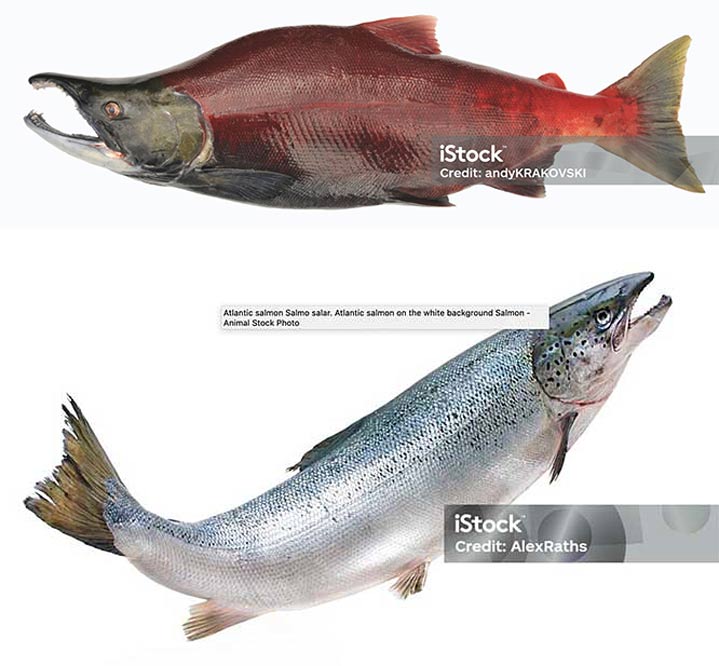

(Let’s face it, a Pacific Sockeye Salmon definitely won’t win a beauty contest against their Atlantic Salmon cousins!)
https://www.traderjoes.com/home/products/pdp/wild-alaskan-sockeye-salmon-fillets-068719


 Trader Joe’s Rants & Raves (mostly raves, a few rants)
Dec 29, 2023 @ 17:26:50
Good to know! I’ll be trying this next TJ’s trip. Thanks!
On Fri, Dec 29, 2023 at 2:13 PM Trader Joe’s Rants & Raves (mostly raves, a
LikeLike
Aug 25, 2025 @ 10:07:22
Thank you for writing this article in the recipe suggestion. I’m definitely a wild salmon snob. Maybe it’s because I grew up in the Pacific Northwest? Regardless, when I went to visit my cousins in Norway and saw the Atlantic fish farms in the fjords, and the environmental destruction that they have done, I just don’t see any reason to even try it. I’ve mostly bought Trader Joe’s frozen wild, sockeye package. I haven’t been able to find it there in months, and I’m starting to feel a little depraved. I’m wondering if you know what’s going on with the supply chain?
LikeLike