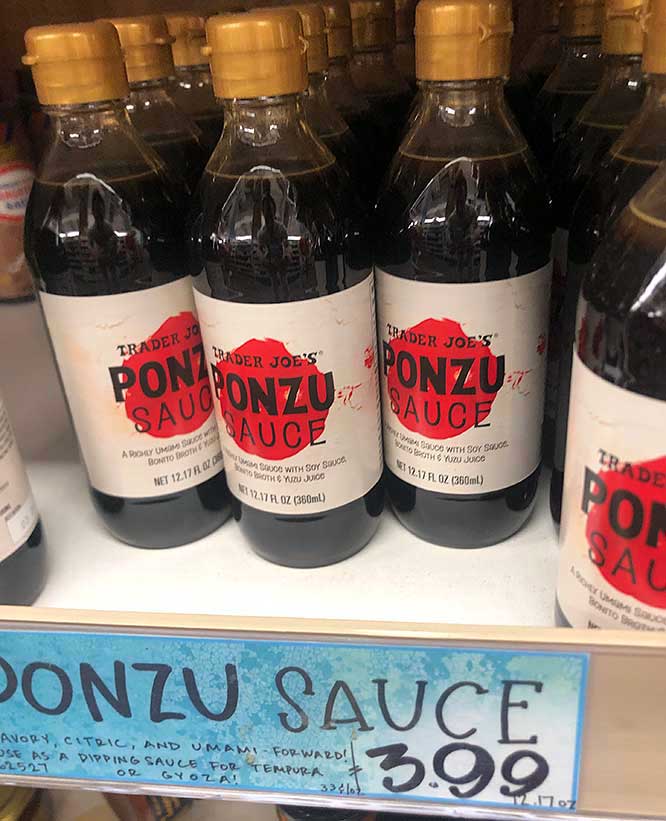
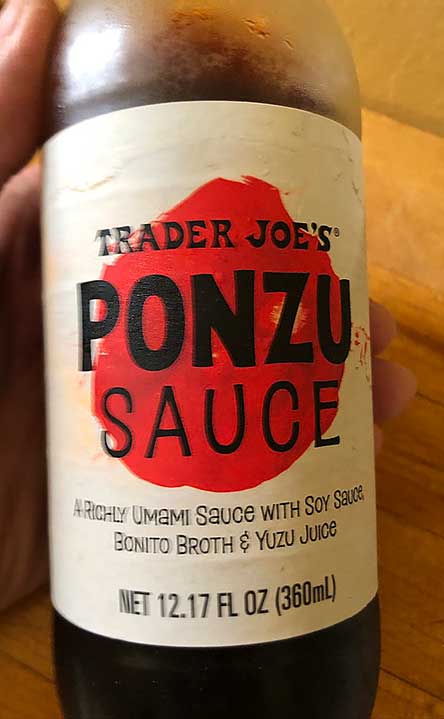
“….tart, tangy, and umami-rich flavor…. Traditionally made with a base of rice vinegar, bonito broth, rice wine, and some manner of citrus juice, Ponzu is a pitch-perfect sauce for seasoning fish for poke and sashimi, but that’s hardly where we’d stop. Made for us by an expert supplier in Japan, Trader Joe’s Ponzu Sauce can add an element of sweetness, savoriness, and richness to all sorts of dishes, from the simplest of rice bowls to the most complex of marinades.” – TJ website
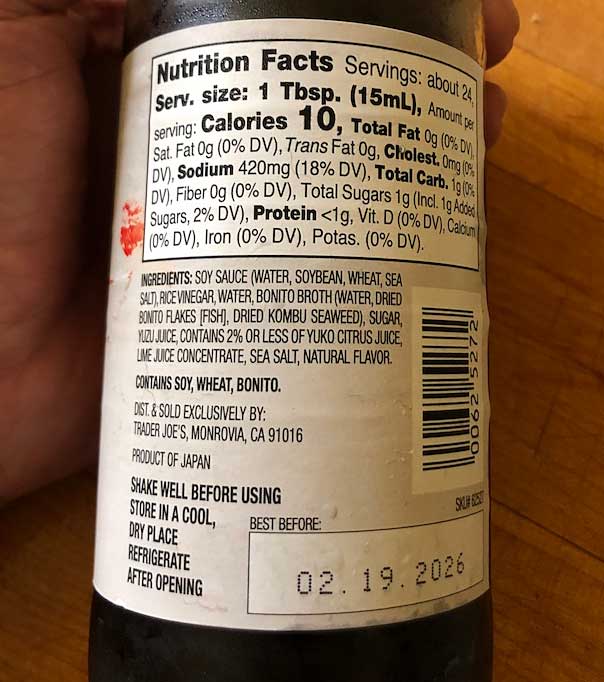
Ponzu is a classic, traditional Japanese sauce which gives umami flavor to things and is usually made with soy sauce plus yuzu citrus. This version is a soy sauce (shoyu ponzu).
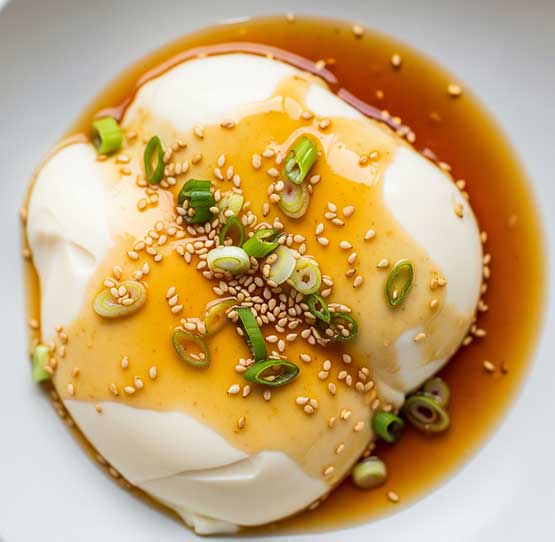
Here’s just one idea to make a super easy summer dish. Take a piece of the very good organic SILKEN TOFU, and pour on ponzu sauce. Done. If you want, add chopped scallions, maybe sesame seeds. That’s just one example of how I use this ponzu sauce.
Trader Joe’s version of ponzu is quite tasty. Savory with citrus-y notes and a little sweetness. Even my (Japanese) wife gave this ponzu a thumbs up.
You can use it as a marinade for chicken or fish, then glaze it on at the end and serve on the size as a dipping sauce too. I have found this a very useful item to have in the fridge.
“….for pretty much any savory application in the kitchen, and especially so for making flavorful salad dressings, dipping with tempura, pan-fried gyoza, and other crispy appetizers, or mixing into burger patties for an extra bonito-powered boost of umami.”
Great for a dumpling dipping sauce too. If you want spicy mix in some chili crisp.
If you want even more citrus flavor (I do) just add a squeeze of lemon juice.
Asian style salad dressing Mix some ponzu with a little lemon juice and tahini.
(NOTE: I’ve read that these have gone VIRAL and can now be hard to find!!!)
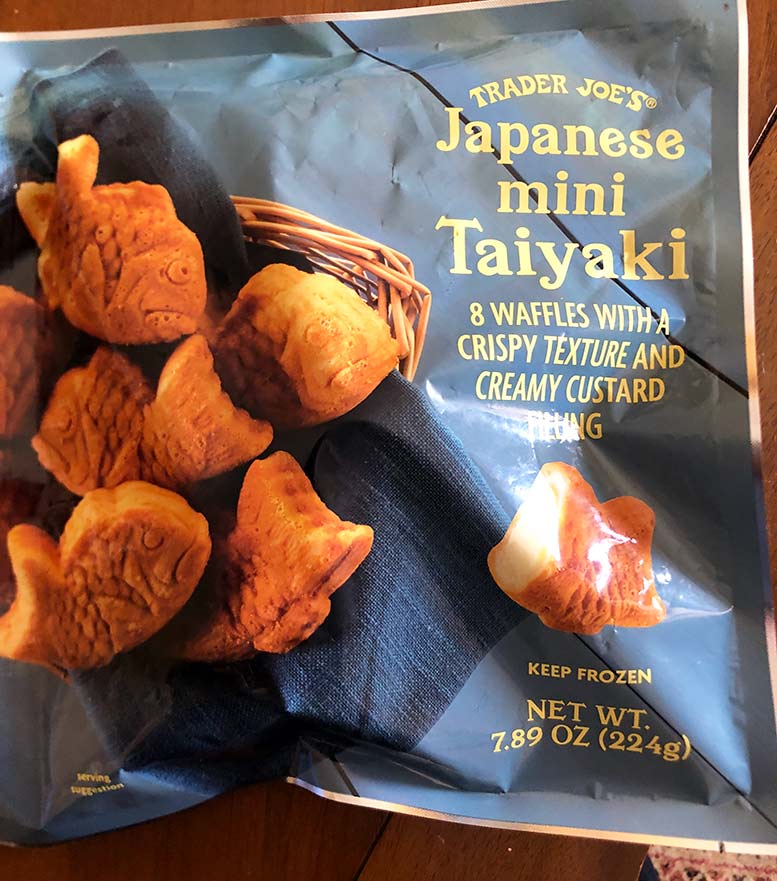
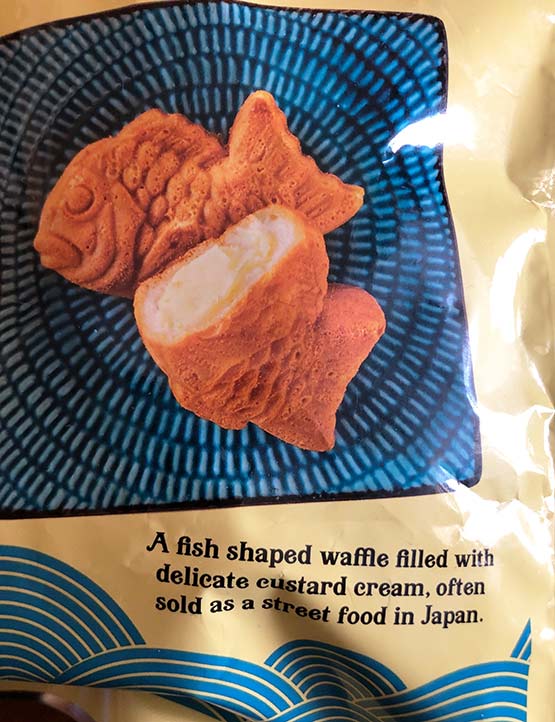
“A fish shaped waffle filled with a delicate custard cream, often sold as a street food in Japan”
TAI – red snapper, considered good luck. YAKI – grilled.
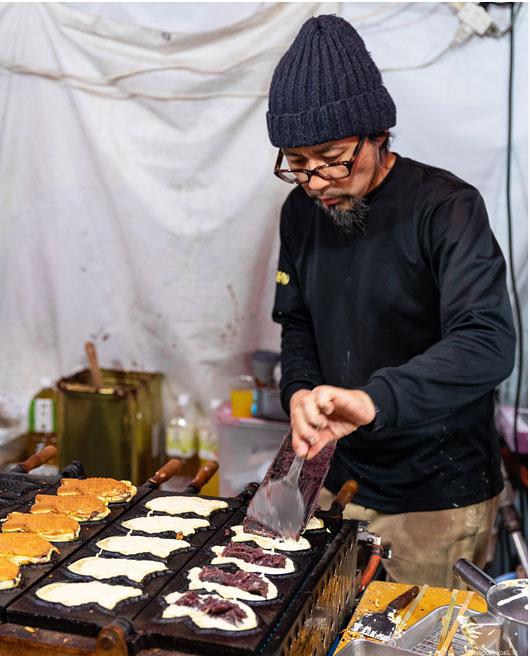
Taiyaki are sweet waffles shaped like fish and are hugely popular in Japan. They are always sold at street festivals where you will find taiyaki vendors like this guy making some.
They make them by pouring batter into iron molds shaped like fish. Cooked until they are golden brown, they get something in the middle then are flipped over. They come out golden brown with bit of a crunchy texture outside while Inside the taiyaki, there’s a sweet filling. Usually its ANKO (sweet red bean paste).
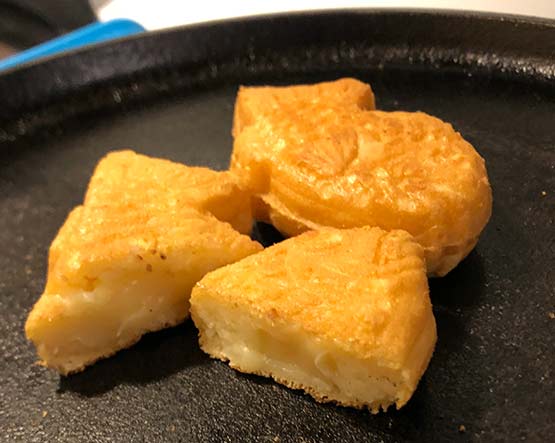
Here in Trader Joe’s Mini Taiyaki you find a yummy custard cream in the center.
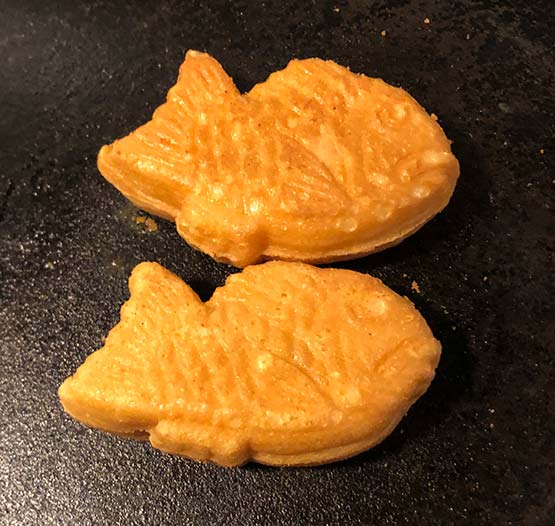
Here’s what they look like.
As you can see they are pretty cute. And you know Japanese love CUTE (“Kawaii”) things. Trader Joe’s mini taiyaki are a little mini version of the typical Taiyaki which are usually much bigger. 4 times the size? Each of these TJ mini taiyaki is maybe a bite or two.
“Brought to us by an esteemed manufacturer in Japan, these bite-sized, perfectly pisciform Taiyaki are as much a feast for the eyes as they are a pleasure on the palate. Every bite starts with the crisp edge of the wonderfully waffle-y exterior, which quickly gives way to the luxurious consistency of the cool custard cream within.”
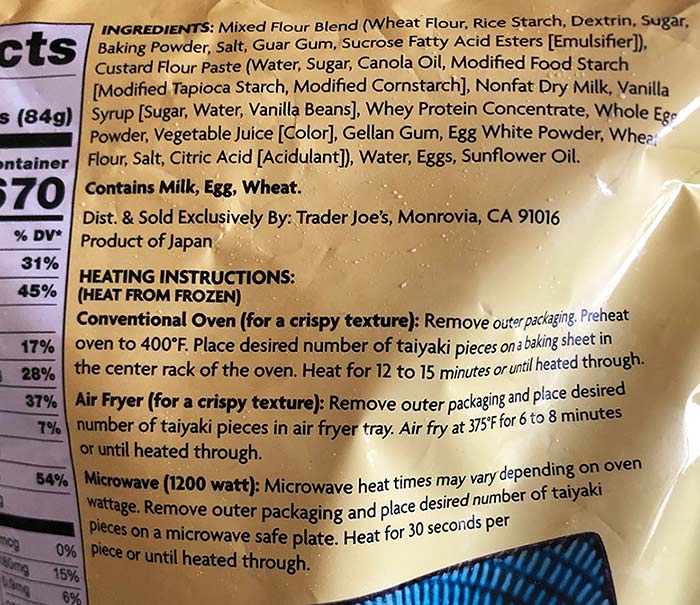
To make these Trader Joe’s says bake these in the oven or in an air fryer. They also say you can microwave these but I suggest you don’t, as they won’t get crispy which they need to be to really be enjoyed properly.
I didn’t do either of these. I just cooked them in a pan on the stovetop which works fine and is easy.
I just took a few of them out of the package, and let them sit for 10 minutes or so to defrost a bit. Then I put them in a hot cast iron pan (or use a non stick pan). Let them cook on one side until they get a lightly golden brown in color or when they look nice and crispy, and then flip them once or twice. It took about 6-7 minutes per side, so around 12-15 minutes total to cook them in a pan.
So how do Trader Joe’s TAIYAKI taste? These mini taiyaki are really YUMMY!
Even my (Japanese) wife approved of these and thought Trader Joe’s did a pretty good job with these. We were pleasantly surprised at how good they are. The only thing she said is she wished they gave you two kinds of filling in the bag, some with custard but she wanted some with “anko”, the most traditional filling.
Still the custard filling inside these is very good and satisfying for a sweet treat.
Trader Joe’s new MINI TAIYAKI are quite tasty and worth trying especially if you like Japanese treats. A package is $4.99. It’s not very big, a bit less than 8 ounces. There are just about 8 or 9 of these little fishes inside. Some people are saying save yourself a trip and “buy two”.
Trader Joe’s Yuzu Kosho – Japanese Citrus Chili Pepper Paste
NEW ITEM!
“Savory, zesty and invigorating with a nice even level of heat”
Trader Joe’s recently introduced this new condiment which you could call an “Asian Citrus Wonder Paste”. Their new Yuzo Kosho paste has an amazing taste that is citrus-y, spicy, zingy and just loaded with Umami. This condiment is made by combining the Japanese citrus, yuzu with green chili peppers into a paste, which typically is then fermented.
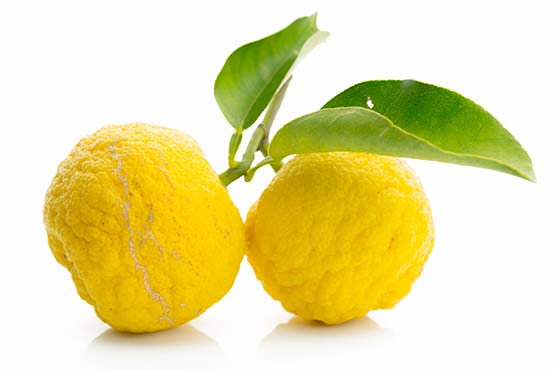
Yuzu as you probably know is an Japanese citrus that looks like a cross between a lemon and a grapefruit.
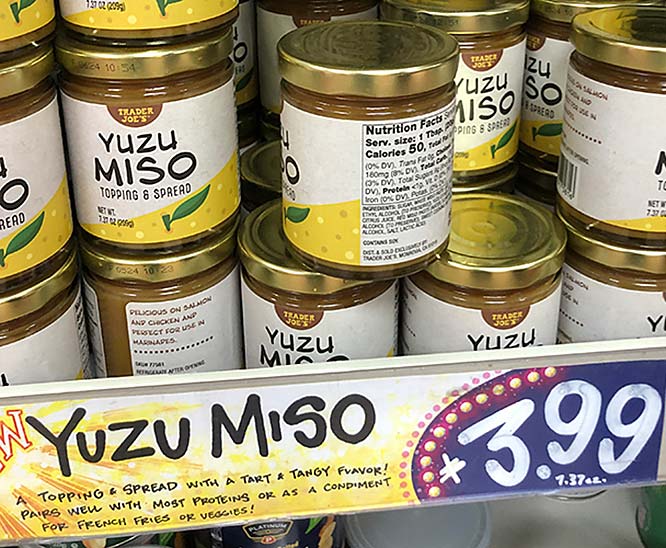
Yuzu has an incredibly unique flavor. Chefs all over the world have fallen in love with yuzu, the juice as well as the flavorful peel. You see yuzu a lot in restaurants now and its a hot trendy item, no doubt one of the reasons Trader Joe’s is really going “all in” on yuzu stuff – they’ve just come out with 3 new Yuzu based products: this Yuzu Kosho, as well as Yuzu Miso and Green Tea and Yuzu spread.
Yuzu Kosho is a traditional Japanese condiment, which I have bought a few times in Japanese stores. I love that Trader Joe’s is carrying it now and for a good price too.
Using Yuzu Kosho: First thing to know is a little goes a long way so just a small dollop will give a big pop of citrus flavor with a bit of heat to your dish. Tasted on its own you will think its salty but you use it small amounts. Of course you may reduce adding the salt you might have used if you use this depending on what you are making.
What is it good with…? Just mentioning one thing, this stuff is just great with fish.
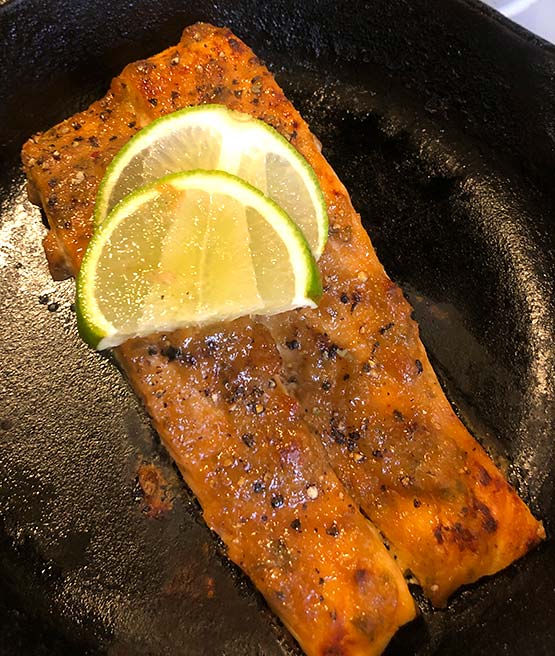
I was going to make broiled salmon yesterday, and remembered I had this new yuzu kosho paste to try out, and was waiting for something to use it with. I was going to make Miso Glazed Salmon so I thought what if I mixed a bit of the Yuzu Kosho in as well into Miso?
I took about a tablespoon or more of the Miso and maybe a scant teaspoon of the yuzu kosho. I mixed the two pastes up together and spread this mixture all over the salmon and just let it marinate for about 5 minutes.
I pre-heated my broiler and popped in the fish in a cast iron pan. I cooked it for about 6 minutes or so, keeping a close eye on it to make sure it didn’t burn. As soon as the top was a lovely deep golden brown I took it out and let it sit for a few minutes to finish cooking in the hot pan.
All I can tell you the salmon was delicious this way. Very yummy, people I promise you if you try this you will like it. I served the salmon with rice and edamame, and the whole dinner was was delicious. The miso and yuzu kosho combo was perfect. Even my Japanese/Korean wife gave my Miso Yuzukosho Salmon dish a big thumbs up. And she is tough !
As well as fish you could use yuzu kosho (and possibly the miso/yuzu combo) with chicken, tofu, mixed into vegetables… frankly almost anything.
Now Trader Joe’s just came out with Miso Yuzu too alongside the Yuzu Kosho. Its probably also good but I do like my miso/yuzukosho combo for the added kick.
“Use yuzu kosho whenever you want to enliven a dish with punchy citrus flavor and heat. But use it sparingly; a dollop goes a long way. Start by swirling a teaspoon into stir-fries, salad dressings, meat marinades, and sauces.”
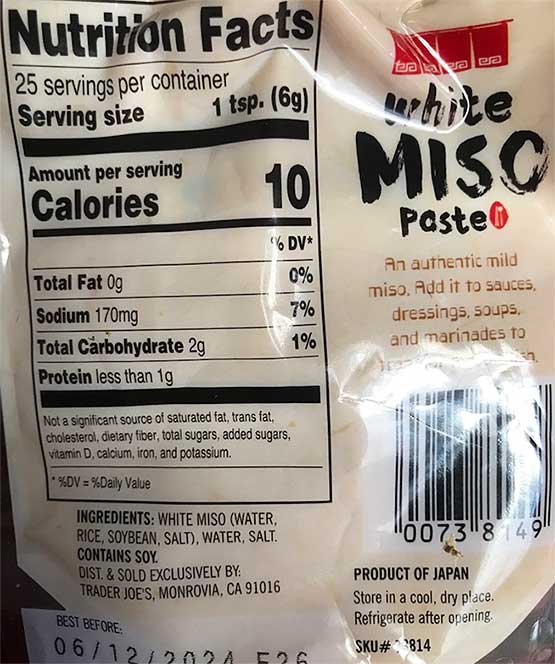
“With a lighter sweeter flavor than other miso pastes, this tasty miso offers nutty, sweet umami to any dish” – TJ
This is very nice white miso paste which is not quite as thick or strong or salty as many Japanese miso’s pastes in tubs are. This one is lighter and not as thick so its a bit easier to use just as is out of the package.
The squeezable pouch make is very easy to squeeze out as little or as much as you need.
This light white miso adds really delicious flavor.
This is a light white miso and I really like this to cook fish or chicken or what have you, usually spread this on and then broil it so it gets a little bit of a char. I used it recently to make some broiled salmon and another time with some mahi mahi and it worked great with both of these fishes. But you could use it on chicken of course as well.
MISO COATED SALMON (or any fish) Coat the fish with a layer of this white miso, then let it marinate it for about 30 minutes or more. Broil (or bake) the fish as usual but keep a close eye on it as the miso will brown and you want it a little browned but not burnt of course. When your dish looks golden brown, remove and let it sit for a few minutes before serving.
Optional: Mix up a bit more of the miso with a little honey and lemon juice to make a light glaze. During the last minute or so of cooking, take out the fish or chicken or tofu your are baking or broiling under the grill. Spread on the miso paste glaze, put it back in and let it cook for 30-60 seconds until the glaze looks perfectly browned. Option: You can also serve some of this miso glaze mix as a sauce alongside your protein.
In addition to fish I find the miso marinade works just as well using chicken and broiling it. It can also be used in soups, as well as in salad dressings, add to ramen or noodles, etc. A little miso added to some butter is great with veggies and other things. I bet it works well even with TOFU.
TJ’s White Miso comes in a handy squeeze pouch. I find this very convenient and easy to work with, to be able to squeeze out some quickly, and its much more convenient compared to the 1 lb tubs of miso I usually buy from a Japanese market. Frankly I usually find one of those tubs somewhere at the back of my fridge a long time after I bought it and maybe it expired six months back (but honestly Japanese miso is so salty it doesn’t really go bad, it can last a year easily)
Trader Joe’s Miso Paste is $2.99 (5.3 oz)
I would buy this again.
“Trader Joe’s White Miso Paste is made of fermented rice and soybeans, and like many fantastic, fermented foods, it has a complex flavor—a mix of savory, salty, and umami. Our supplier is a 5th generation miso maker in Japan. Their process involves a shorter-than-standard fermentation period to yield a delicate, umami flavor, making this a very versatile Miso. Most commonly used in savory preparations, White Miso adds depth to soups, sauces, and dressings. You can use it in marinades for meats, fish, and tofu, or as a dip”
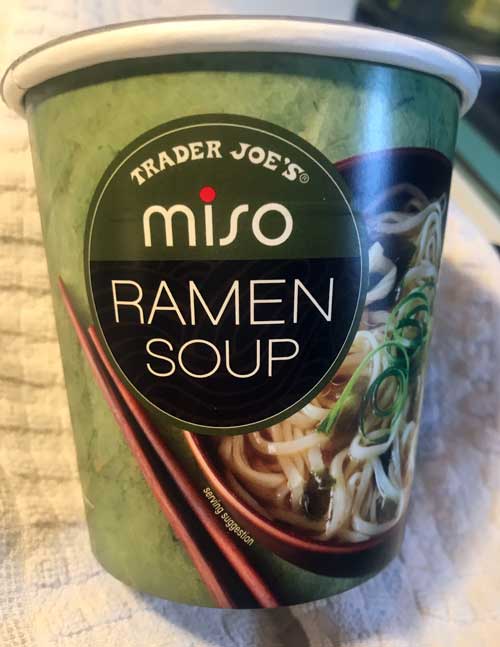
My wife bought this “MISO RAMEN SOUP”. Now she loves ramen and will usually buy her favorite, Korean Shin Ramen, which is very good. It costs more. She made this and when I asked her what she thought her review was pretty short: “I’ll never buy this again”
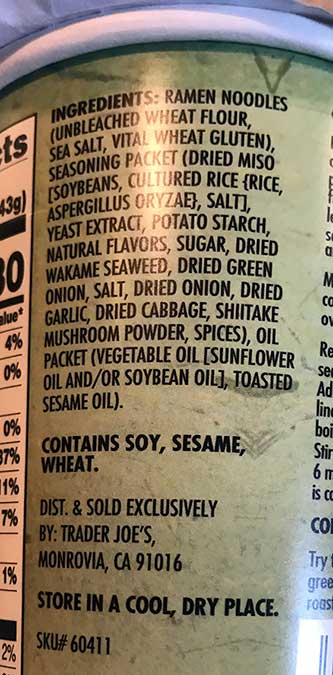
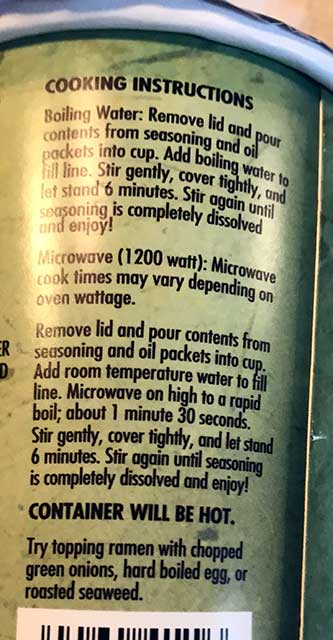
Inside the cup there’s some noodles which don’t look like the dried ramen you are used to. These are straight wheat noodles which look semi-dry (pre-boiled?). There’s not a lot of noodles. There’s a dried packet of stuff (the soup) plus a little clear packet, which we thought was one of those drying packets and almost threw it away. Nope, its part of the ramen set; The clear packet contains a little bit of oil you add along with the dry packet of miso soup.
I tasted her ramen and here’s what I thought of this product.
The Good: The broth was actually pretty decent. Better than I expected. It tastes like a Japanese miso soup broth. There was even a piece or two of wakame (seaweed) floating around in the soup. Some umami from seaweed and mushrooms. The Ingredient list reads fairly natural; you don’t see wierd names of chemicals just dried ingredients. Broth 7/10
The Bad: Ramen? Well they really messed up the “ramen” part of this “miso ramen soup”. Noodles are lousy. We both thought the noodles were not very good and to add insult to injury they are very skimpy with the noodles. These noodles are not dry but a little flexible, like a semi-dried, pre-boiled noodles? They barely had any texture or bite to them after the recommended six minutes. Very MEH as they should be the star. Noodles 5/10
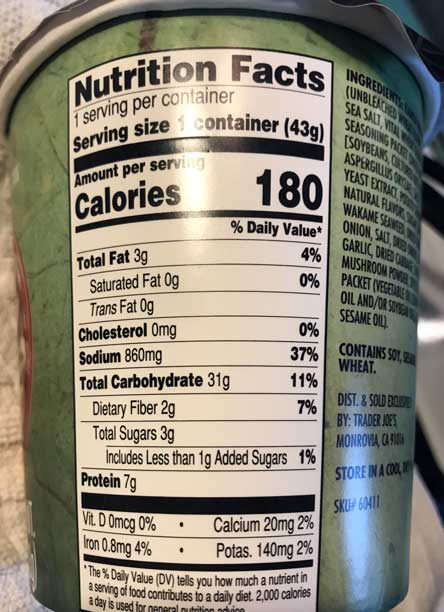
The Sodium content is listed as 870, which is almost 40% of your daily recommended level of salt. We cut that down by only using about 3/4 of the packet. Naturally that will make the broth a little less strong. It was fine for us. All instant ramen tends to have quite a bit of sodium. Always check the labels. This really applies to all the Asian products at TJ’s.
If you decide to actually try this, it may be better if you try adding a poached egg and chopped scallions as they suggest.
$1.89
I had an idea that since the broth was not bad but the noodles are Meh I thought one might combine this with the packet of cheap ramen dried noodles you might have in the house. I used to get them 5/$1 a few years back!
If you want good ramen, Korean Shin Ramen runs rings around this and most instant ramen though it costs more.
“Our Chicken Karaage [ka-RAH-geh] is crispy on the outside and tender on the inside, made with a Japanese-inspired recipe. It begins with bite-sized pieces of boneless, skinless, leg meat that have been tenderized and flavor-infused after marinating in rice wine (mirin), soy sauce, and white wine vinegar—along with garlic & ginger powders.”
Trader Joe’s frozen Chicken Kaarage is another addition to the growing list of Trader Joe’s Asian frozen prepared frozen food offerings, especially chicken dishes.
Some people on the internet rave about this KARAAGE (kara-ag-eh) .
My honest review? Now as with all of Trader Joe’s Asian foods you really have to know what the “real thing” tastes like to be able to judge. Real Japanese Karrage consist of some marinated chicken which gets a light coating of cornstarch then is shallow fried till golden brown. Basically think of it as Japanese fried chicken. It’s delicious.
Is Trader Joe’s KARAAGE like what you might get at a Japanese restaurant? I’m afraid not people. However for what this is, I think its not bad. The crispy chicken is actually pretty tasty and juicy. The main problem with this is obvious: just has way too much breading. I put this stuff in front of my (Japanese Korean) wife who looked it it and told me they looked like “chicken nuggets”.
Pros – The marinated dark meat chicken is actually tasty, just as long as you get a big piece with enough chicken to match the breading. Dip it in a little of the mayonnaise based sauce they give you, to which you added fresh lemon juice. Ditto mixing in a little TJ’s YUZU hot sauce.
Cons – Way too much breading. The big pieces are OK however you also get many small pieces where the breading totally overwhelms the chicken. You will even find little pieces basically of just breading with almost no chicken! Should have better quality control (but that would cost). Plus this lists many ingredients.
Though the instructions don’t say you can cook these on top of the stove in pan. I cooked it that way on medium heat first covered for 5 minutes then removed the cover and cooked for maybe 10 minutes, turning on all sides till golden brown and crispy. That’s the way I cooked them in the picture here. Or cook it in an Air Fryer or in the oven.
Defrost the sauce in warm water for 5-10 minutes. Cut an end and squeeze it out.
What to eat with this? This might match well with frozen Japanese Fried Rice and some edamame.
This stuff is super. I love it. Limited supplies so grab a bottle while you can if you are interested!
In case you are not familiar with it, Japanese yuzu is a citrus fruit that looks like a lemon, but is quite different and unique with its own distinctive flavor. It’s used quite a bit in Japanese cuisine. Among other things they use it to make Yuzu Kosho, a spice of the zest combined with chile pepper for a spicy citrus-y condiment. Yuzu kosho has been discovered by chefs here. “The secret weapon condiment chefs are putting on everything… It’s the closest thing you’ll get to a silver bullet condiment that’ll instantly impart depth to your dish. Chefs know it—they’ve been using it at their restaurants for years—and it’s time you did, too.”
This sauce has yuzu kosho combined with “small batch vinegar” to make a hot sauce that you can add a few drops or more to any food, to give it a real spark of flavor.
The sauce is really tasty and gives a nice citrusy kick to anything you put it on. As far as the spice level here, I would call it just mildly spicy, maybe “medium”, certainly not knock you head off spicy, so it may appeal to many people who can’t take too much heat.
What can you use Yuzu Kosho sauce on? Almost anything. The question might even be rephrased as what can’t you use it on? Its good on chicken, fish, salads, eggs, meats, tofu, pretty much anything you can think of. I just tested it on good old cottage cheese and it elevated something boring to a new taste.
This is worth trying if you like to taste unique items as as they say “limited” if you want to try it, grab one while you can. $3.99 a small (100 ml) bottle.
(UPDATE: Reported to be Discontinued but they have a lot of similar items to check out)
“A FIERY snack that you may not be able to stop eating”
These snacks are Made in Japan, a place they are very serious about snacks.
Trader Joe’s CRISPY CRUNCHY SPICY RICE MOCHI snacks are (really) crunchy bite sized nuggets made from rice powder and coated with spices. A lot of spices! Now one never quite knows when Trader Joe’s calls something “spicy” exactly how spicy they mean. In this case I assure you TJ’s is Not Kidding with the spicy! These are SERIOUSLY spicy as in mouth on fire spicy (or “head on fire” spicy if you look at the the package) The cute pictures on the package are not by accident, they are warning that this Bag Contains Really Spicy Stuff! So yes while these – actually yummy – snacks are super hot, they are more than just “spicy”, they are really tasty (as long as you can handle heat). I actually liked these and I give them a thumbs up, if you like spicy stuff. They are super duper CRUNCHY bites liberally coated with spices including : Black pepper, white pepper, chipotle powder, habanero powder, red chili powder... If you read that list I’m sure you get the picture. Again these are not just fiery, they’re quite tasty with a bunch of other interesting flavors as well such as citrus peel, paprika, cumin, cardamon, ginger, cinnamon….. So we are talking fiery flavorful and yummy all at the same time. Even addictive as they say? I can eat one or two and then kind of take a break for moment before eating another one then drink something to cool down the tongue. You should have some drink near you eating these. They would probably be great with an ice cold beer. I liked them on their own. I also found I especially liked them and they were even better with a little something else to kind of balance and mellow out the heat a bit. They were good with some cheese and even with a little cream cheese and probably great with some kind of dip, especially yogurt based? Anyway, these are really something. If you like heat you will enjoy these, they are more than just hot, they’re super tasty. Oh and wash your fingers after you are done eating these, lest you accidentally touch your eyes or something.
Trader Joe’s FURIKAKE Japanese multi-purpose seasoning
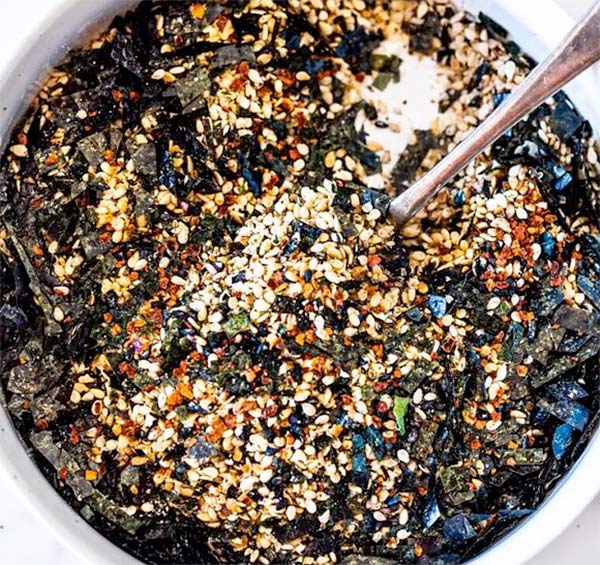
“Furikake” is so typical in Japan you’ll probably find a shaker of it next to the salt and pepper in most any eatery, as well as on most people’s kitchen table at home. So what is FURIKAKE? Furikake is a seasoning made up of finely chopped dried seaweed (Nori) along with sesame seeds and other flavors (even sometimes tiny whole dried fish!) Japanese will sprinkle furikake on rice to to enjoy the combined flavors, and it is really delicious on rice. However one can use it elsewhere too. Besides trying this on rice, sprinkle some furikake over some grilled fish (salmon!), or chicken, meats, on top of eggs, noodles or a bowl of ramen. It’s really versatile and goes with so many foods, all of which is why Trader Joe’s calls its “multi-purpose seasoning”, it really is. This TJ version of Nori Komi Furikake is a basic version containing sesame and seaweed. In Japan they make lots of kinds with different flavors (like dried salmon and other fish, shiso leaf, green tea, wasabi, sour plum, etc) Here is some on Amazon with 8 different kinds (and its crazy expensive, yikes!)
You know those times when you have “nothing to eat” in the house?? Well say you at least have rice; eggs and this jar of FURIKAKE… Top a bowl of rice with a fried but still runny egg, and sprinkle a liberal amount of Nori Komi Furikake over everything. Mix it all in with a spoon. Voila! EASY. YUMMY. DINNER. This is a great simple, satisfying dish. You should try it, period. (BTW in Japan where you can get can get super fresh eggs, they even crack raw eggs into the hot rice, aka GohanTamago).
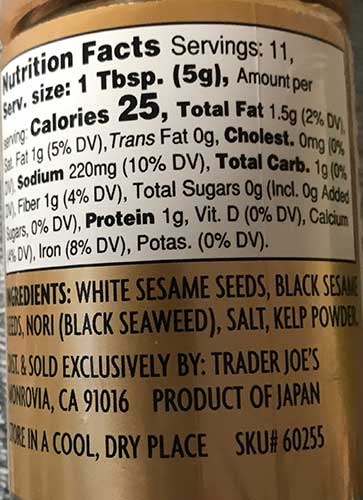
Trader Joe’s Nori Komi Furikake contains: white sesame seeds, black sesame seeds, nori (seaweed), salt and kelp powder (yup, more seaweed!) Seaweed of course contains glutamates. Glutamates have “Umami”.
Personally I have to have Furikake in our pantry at all times. A jar will last some time (you can keep in the fridge too). You’ll find it in TJ’s spice section and it is really worth checking out. A jar is $2.49. At a Japanese grocery it would be twice that. Want more info and ideas: check this link, even how to make your own!
“The secret to cooking Ahi Tuna is not to overcook it”
What is Ahi Tuna? “Ahi” is Hawaiian for YELLOWFIN TUNA
“Yellowfin tuna, scientifically known as Thunnus albacares, is a popular species of tuna found in tropical and subtropical waters worldwide. They are often marketed as “ahi” in Hawaii and elsewhere.”
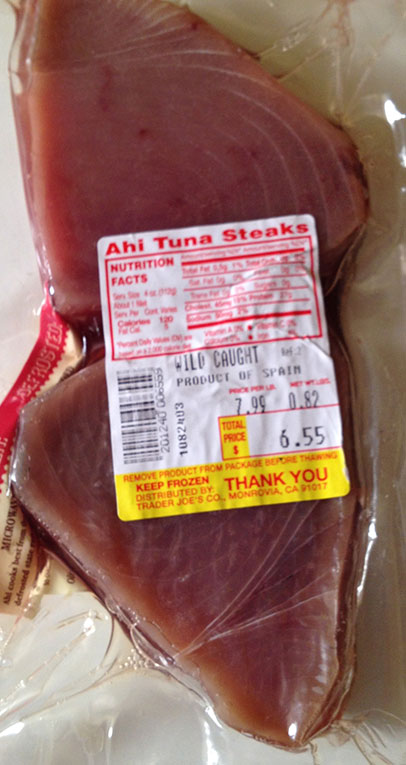
Trader Joe’s sells AHI TUNA STEAKS, in the section with their other frozen fish.
My package was labled “Wild Caught, Product of Spain” (fished from Spanish waters in the Atlantic)
Ahi Tuna is one of my favorite fishes that TJ’s carries. and I highly recommend trying it if you never have before. It’s so good, meaty and satisfying.
If you have any leftovers, its delicious served cold the next day, maybe over a bed of rice or a salad.
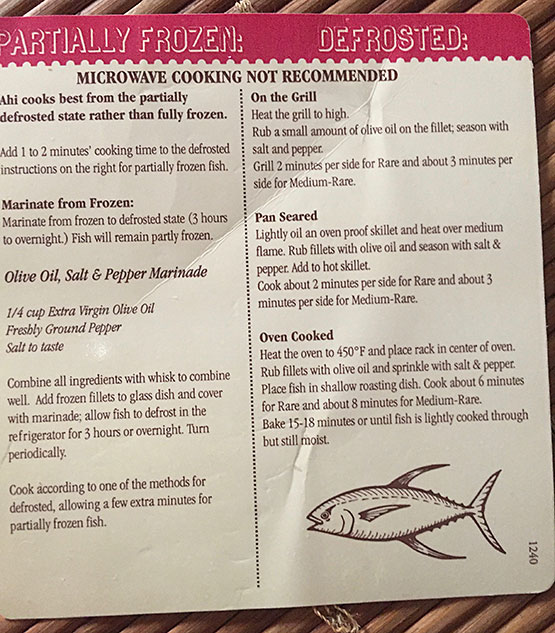
How To Cook Ahi Tuna: First off, defrosting the fish. The best way will be a slow “overnight” defrost in the fridge. While the slow defrost will give the best result, if you didnt plan ahead, you could you can try putting the package of fish in a bowl in the sink, then running a slow stream of cold water over it. Leave it like that. That will take perhaps an hour to defrost that way.
TIP: Do Not Nuke the fish to defrost it; it will ruin the texture of the fish, making in mushy.
The package states you should “remove from package before defrosting”. I’m not quite sure why… anyone have a clue? Anyway I defrost it in the fridge overnight in the package and it seems fine.
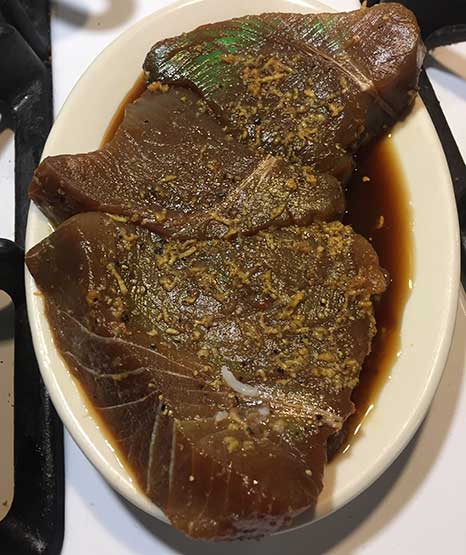
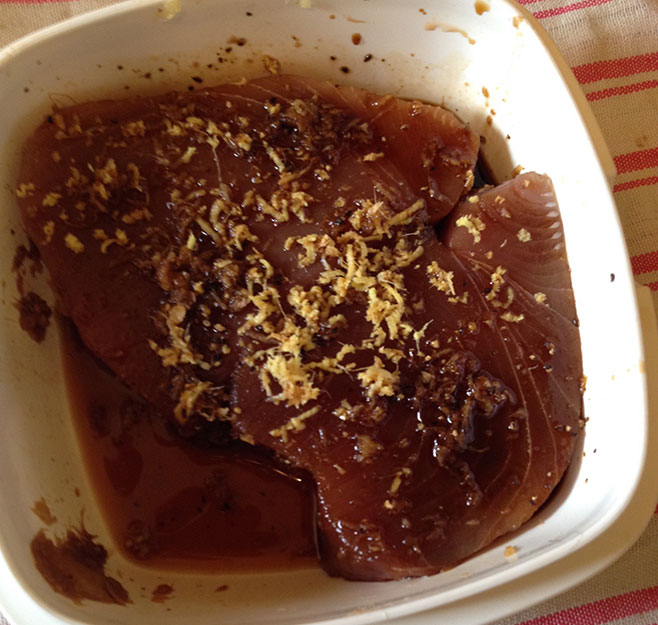
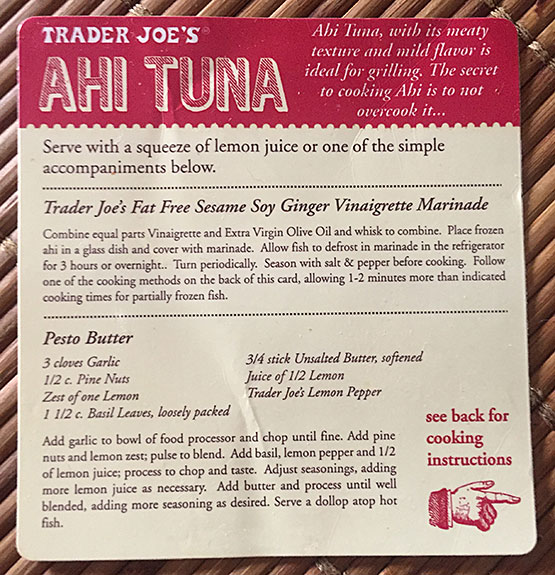
MARINADE: Once the fish is defrosted I marinate it for a half hour to an hour before cooking. As far as marinades go, I generally make a typical Asian/Japanese style marinade: Soy sauce, fresh grated ginger, fresh ground black pepper, a pinch of honey or brown sugar, plus some oil, either olive oil or better still a teaspoon of TJ’s dark roasted sesame oil. You can add some type of acid if you like: a tiny amount of cider vinegar, lemon juice, or sake if you have it. You should serve it with some fresh Lemon or Lime.
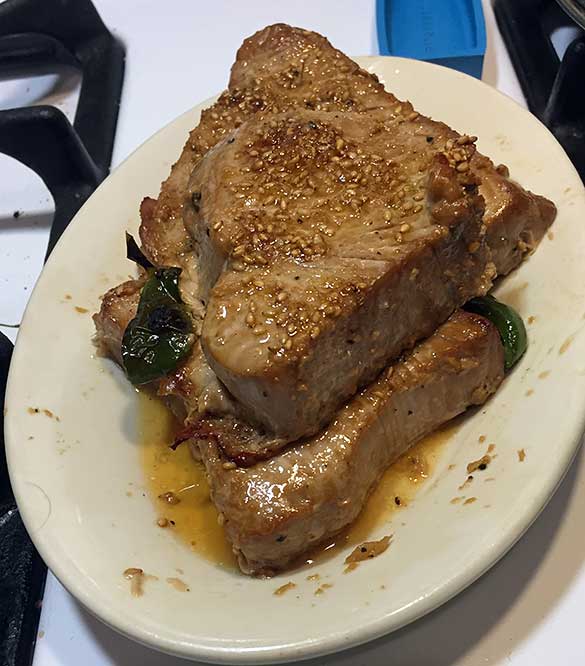
Cooking Ahi Tuna: The first rule of AHI tuna is don’t overcook it. Its very easily overcooked. It is crucial that you don’t overcook ahi tuna as it can dry out easily. So be careful with your cooking time. Personally I think AHI is best cooked in the Japanese “Tataki-style” way which is just searing the outside on all sides and leaving the center a bit pink (See pic above).
I generally cook it in a black cast iron pan over med-high heat with a little oil, and/or butter, searing the outside for 60-90 seconds on one side then turning with tongs to cook the other sides for a minute. You can use the tongs on the sides but again be careful not to overcook your fish. After you do it once or twice you will get the hang of cooking this way.
When done, take the fish out of the pan, and let it rest on a plate for a few minutes before you slice it. Which you will do against the grain like a steak. Be sure to save the pan juices and any juice that runs out on the cutting board to pour over your fish.
You can deglaze the pan with sake, rice vinegar, or even a splash of water, or some extra marinade that you saved at the beginning. I found that if you marinated the fish and use that marinade to deglaze the pan there is protein that coagulates when you cook it, so it glops up a little (I just thin it with soy and some water, it doesn’t bother me too much, it makes it thicker thats all). If that gloppy stuff bothers you, don’t use the marinade, make a fresh sauce to serve with the fish. Here’s some ideas for sauces….
“Butter Shoyu” (Soy Butter Sauce) Put a fat dollop of butter in the pan along with a little soy sauce, a terrific combination. Mix it well and and pour over the Ahi. Serve with slices of fresh lemon or lime.
PONZU: Another classic Japanese sauce. Combine Soy sauce and fresh Lemon Juice. Do not cook this, just mix together. A bit of grated lemon rind would be a gourmet touch.
As in the photo of my finished Ahi, it should end up seared on the outside and pink in the center, just how pink is up to you. I like mine like it is in the thickest part, the center (just this side of raw) while my wife likes it as it is cooked on the ends (medium) which I think of as overcooked. As a final touch, I sprinkled some sesame seeds on top, sliced it against the grain, and put it on a bed of arugula, pouring the pan juices over the top. Ahi Tuna is really delicious and I am sure your family will also love this very steak-y fish.
You could even try it as “Poke” I guess (ceviche style). I am willing to eat it this way but my (Japanese) wife won’t let me make this as poke as she says this is not “sashimi grade tuna” (true) which costs three times as much, selling for about $25/lb instead of this at $8/lb. So at 8 bucks a pound this is a another good deal from Mr. Trader Joe.
ASIAN MARINADE: 2 tbs soy sauce; 1″ peeled fresh ginger, grated; fresh ground black pepper, a little honey or brown sugar, teaspoon of sesame oil (or olive oil) plus lemon or lime juice for a marinade (you can make a bit more and save some to serve on the side). Marinate in the fridge (on fully defrosted fish) for 30-60 minutes turning it once. Cook as desired.











 Trader Joe’s Rants & Raves (mostly raves, a few rants)
Recent Comments