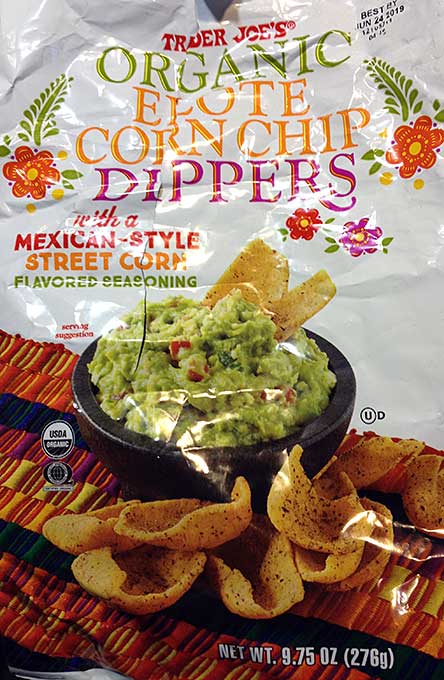
“Trader Joe’s Organic Elote Corn Chip Dippers have the delectable flavor of Mexican Street Corn in a crispy snack….chipotle, habanero kick, smoky, spicy, heat…. Melt cheese over them for a punchy nacho, crumble atop scrambled eggs… Guacamole….” (from the package)
These may be the best chips Trader Joe’s sells. So good! Terrific product.
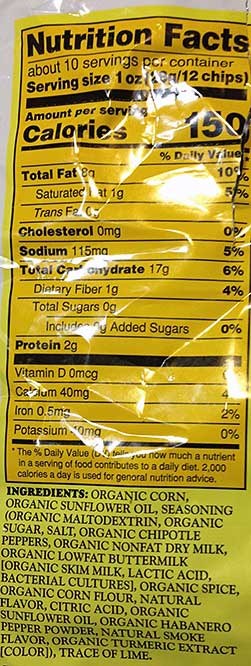
Trader Joe’s Organic Elote Corn Chip Dippers are a spiced up version of the also excellent regular plain Trader Joe’s corn chip dippers. For this “Elote” version of the chips they add a lot of spices for a spicy delicious variation that recalls Mexican Street Corn (Elote). These are so flavorful and honestly they are pretty spicy* just eaten on their own. If you don’t eat these with something (say guacamole, dip, cheese….) your mouth will probably feel a bit on fire from the chipotle and habanero pepper seasonings. Still not crazy, a tolerable heat unless you’re really spicy-adverse. Naturally just like the plain versions, the shape of these thicker “dipper” shaped corn chips make them perfect to stand up to any dip of any kind without falling apart.
These match especially well eaten with other things, especially guacamole of course, or even just salsa. I even sometimes enjoy eating these Elote Corn Chips with something plain like cottage cheese or Greek yogurt, which balances the heat level. You can even crumble these up and put them on things (they suggest atop scramble eggs, that should be great) If you just put grated cheese all over these for nachos you wouldn’t need any other spices, so I think these could make super easy nachos And naturally some beers will go great with these chips, to put out the fire in your mouth.
The Elote spice dippers costs a little more than the plain version of TJ’s Organic Corn Dippers (I think gone up to $2.99 now?)
UPDATE: * These don’t seem to be quite as spicy as they were before. I can’t tell if they’ve changed the recipe or maybe just the lot I got… (if anyone has ideas on this, please leave a comment) I have had a lot of experiences with some Trader Joe’s products I first tried getting “toned down” over time.
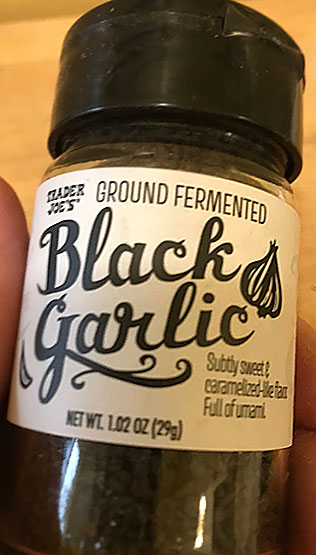
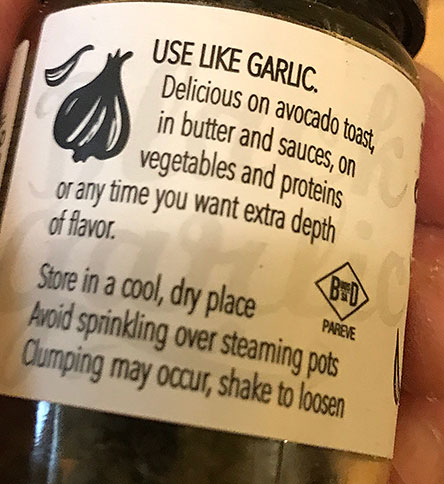
“Use like garlic. Delicious on avocado toast, in butter and sauces, on vegetables and proteins, or any time you want extra depth of flavor”
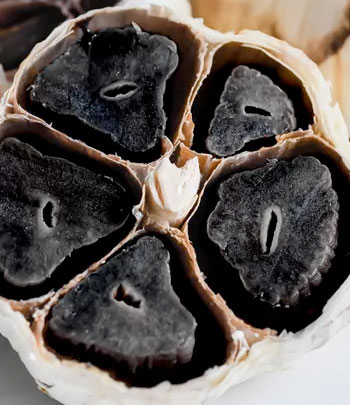
This is a pretty interesting Trader Joe’s product, a bit of an unusual find. Now a few years ago, they sold something in the produce section labeled “Black Garlic”. It was from Japan. It basically looked like a whole head of garlic you had forgotten about in the pantry that had shriveled up and turned completely black! Wild looking! I tried it. Inside shriveled shells were cloves of black garlic inside were softish and absolutely delicious, chock full of UMAMI. I found it to be a kind of amazing, and pretty unusual product for Trader Joe’s to carry. This stuff eventually vanished or was discontinued, anyway I stopped seeing it. Now a year or two later, I noticeed this small jar in the spices section. “Ground Fermented Black Garlic…Made In South Africa”. The black garlic has been dried and ground up into little tiny black bits that can be sprinkled onto things. It tastes garlicky but different from fresh garlic or garlic powder for one thing this was fermented. It’s full of Umami, adding extra depth of flavor to whatever you put it on. I did think it’s a little on the pricey side at $2.99 for a tiny 1 oz jar but I have found it does last a bit. It’s terrific added to sauces and as they mention vegetables. I am trying this on so many things. Avocado anything especially. I am thinking this is a hidden gem that many will look at and bypass and it may vanish in the future. So as we don’t know how long this product will last, if this sounds interesting, grab one to try.
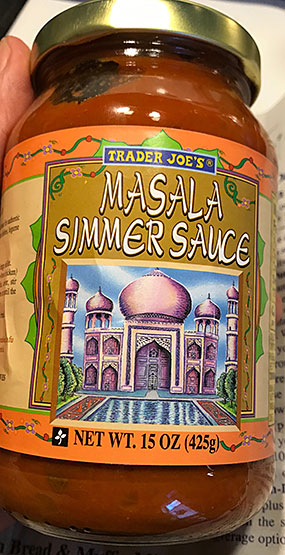
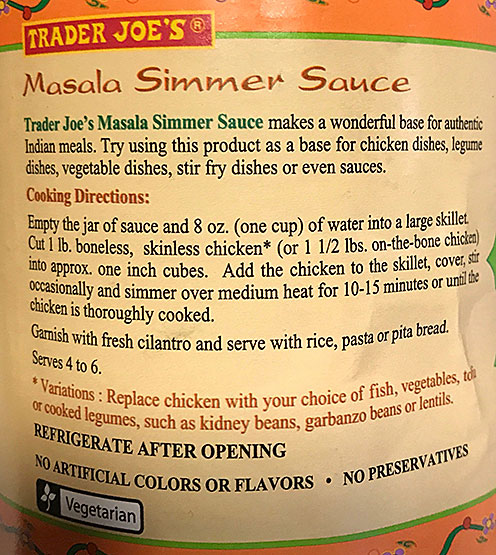
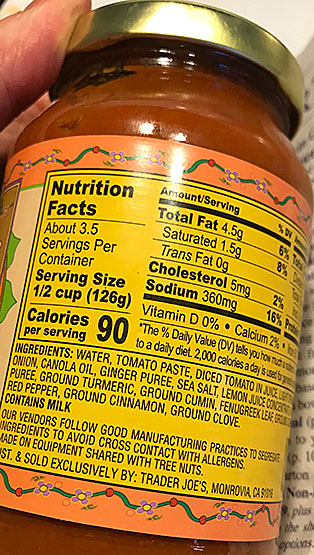
“Trader Joe’s Indian Masala Simmer Sauce makes a wonderful base for authentic Indian meals.“ Masala Simmer Sauce is a Indian style spiced tomato-based sauce which can be used as the main sauce component to easily make a tasty Indian inspired dish that could come together in as little as 15-20 minutes. We made a very tasty Indian style stewed dish with chicken and vegetables using the Masala simmer sauce. It turned out really tasty, served with basmati rice and Naan and some chutney. The sauce is concentrated so you can thin it with water as they suggest (TIP: after emptying the jar into the pot just half-fill it with 8 oz of water, shake it up and pour that into your pot). Or if you want to make a coconut milk version use 8 oz of coconut milk instead of water. I haven’t tried that yet but I know that would make a wonderful dish.
The spices used in this include: pureed ginger, tumeric, cumin, fenugreek, red pepper, cinnamon and clove. All of which combine perfectly with the tomato base to make a very delicious combo. Naturally there’s nothing stopping you from adding some more spices, and I’m in that camp. I had added additional chopped ginger and fresh garlic plus a 1/2 chopped onion which I browned up first in some ghee (butter) before adding the sauce. As they suggest on the label, this sauce works very well to make a stewed dish with boneless chicken, either breast or thigh meat. Even tastier might be chicken on the bone which one would cook 20 minutes more but boneless works fine and is easy. Add in some frozen veggies (peas, or haricot vert green beans, or edamame) during the last five minutes if you like. I do. Serve the finished dish with basmati rice and some Naan for sopping up all that delicious sauce. We ate this with TJ’s MANGO GINGER CHUTNEY which matched beautifully. Of course one can make this strictly vegan or vegetarian. Just use either tofu and/or just vegetables (veggies, plus beans for protein like chick peas or lentils….) In short, TJ”s MASALA SIMMER SAUCE can be the base of a very tasty dish which is easy and delicious. A 15 oz jar was $2.69.
(fall seasonal item) OK, So I’m not really one of those people who goes nuts every Fall for Trader Joe’s “everything pumpkin” thing which frankly I find can be a bit much. Seriously… Pumpkin Dog Treats?! Pumpkin Hummus?! Come on.
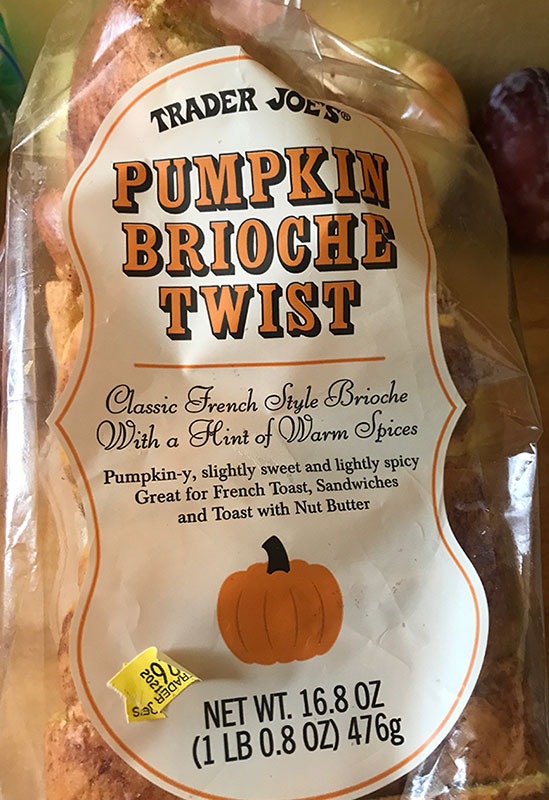
However, that doesn’t mean Trader Joe’s doesn’t have a few pumpkin related items which are actually quite good and worth checking out. Here’s one of them: the Pumpkin Brioche Twist bread. It’s really good!
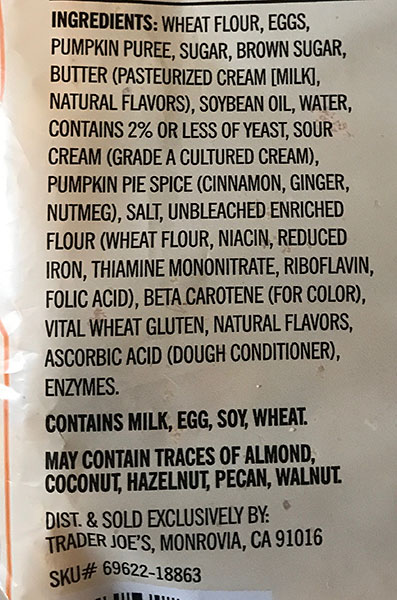
Now I’m absolutely in love with TJ’s FRENCH BRIOCHE. So when I just saw this new seasonal variation, PUMPKIN BRIOCHE TWIST, I had to get one of these to try. Not only does it look really good, it is in fact excellent. It isn’t heavy in the pumpkin spices department, there is just a subtle hint of spice going on and if I didn’t see pumpkin listed in the ingredients I may have not even known there was any pumpkin in it. So personally for this very reason, that they have done the pumpkin thing as subtle, I find this quite good.
This brioche is terrific toasted, either spread with butter or cream cheese and possibly some jam. I haven’t tried it yet to make French Toast but I am sure that this would make fantastic French Toast*, so I would give that a try that for sure. You might try this broche toasted up gently and spread with grass fed butter, a sprinkle of brown or coconut sugar and a light dusting of TJ’s Pumpkin Spice (or cinnamon) it you want something yummy around Halloween time. If you are into the whole TJ pumpkin season thing I think their Pumpkin Butter (pumpkin spread?) would be good on this.
The PUMPKIN BRIOCHE TWIST is $3.99 (same as regular sliced Brioche)
* UPDATE – I finally made French Toast with this pumpkin brioche twist today. It was SO GOOD. Wow, this bread is super as French Toast! A Must Try.
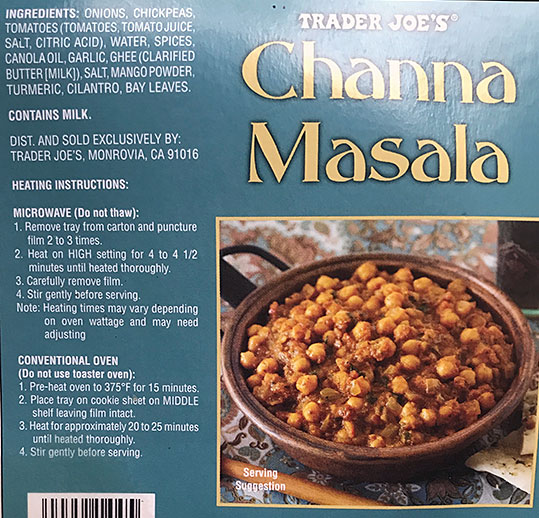
Trader Joe’s Channa Masala (spiced chick peas with onions, tomato and spices)
Vegetarian
Trader Joe’s has quite a number of very good Indian foods, as frozen entrées.
Many of them are worth exploring, but this is one of my favorites. The next time you are thinking of an “Indian food night” I would definitely recommend checking this dish out. Trader Joe’s “Channa Masala” is very flavorful and authentic tasting. Whenever I eat this I usually think, this could have been delivered from an Indian restaurant. That is how well spiced the dish is.
Ingredients include onions, chickpeas, tomatoes, spices, garlic, clarified butter, mango powder, tumeric, cilantro, bay leaf….
To cook it, you can either heat it in the microwave or you could cook it on the stove which is the way I usually do it. I let it defrost for about a 1/2 hour, then slip the frozen puck out of the package and put in a pan with a tablespoon of water. I always eat this with Naan and Basmati Rice.
PS – No one says you can’t add something. I sometimes will add, for example, greens, like some packaged “greens” (kale, etc) or easier still frozen spinach, plus a pat of butter. This variation with some greens makes an excellent combo and makes it into a bigger meal. You can even poach an egg in the simmering channa masala for even more protein.
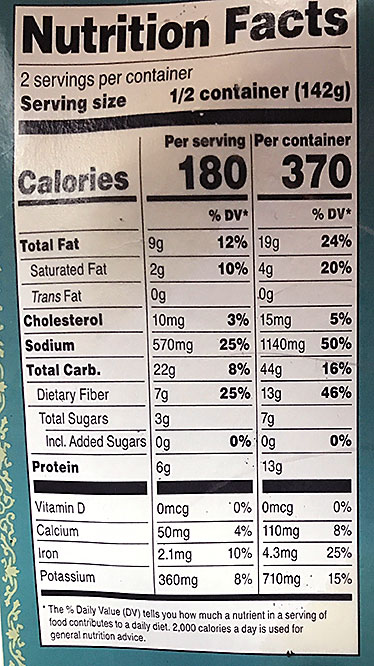
Channa Masala (10 oz package) $1.99 $2.99 (price increased)
Note: 1/2 container has 570mg Sodium or 25% of the recommended daily amount, therefore eating the whole thing by yourself would be 1140mg sodium or about 50% of the recommended daily amount
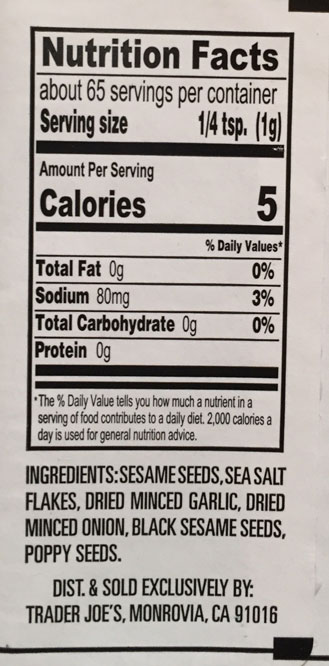
Is Trader Joe’s “Everything but the Bagel Seasoning” blend the bomb that everyone on the internet says it is? Well, yes. It’s terrific. It’s a classic blend of seasonings which obviously, bagel makers originally threw together perhaps a hundred years ago. TJ’s has an excellent version which is a blend of: white sesame seeds, sea salt flakes, poppy seeds, dried minced garlic and onion plus black sesame seeds. Now if by any chance you happen to be a “New Yawker” and grew up your whole life intimately acquainted with “Everything Bagels” then you already know how good this seasoning tastes. As a kid the Everything Bagels were frequently the ones our family usually fought over in a batch of fresh H&H assorted bagels my dad used to send us out for.
When Trader Joe’s introduced this seasoning blend it was such a major hit, sometimes it even got sold out. It just flew out of the store. Its so successful that TJ’s have now even started putting the seasoning on other products, such as smoked salmon (a great combo) and I even saw it in a new popcorn variety! In my opinion it’s especially the dried garlic toasty bits that make this so good. I really enjoy sprinkling EBTB on top of a TJ Artisan everything bagel topped with cream cheese and tomato (or sliced cucumbers or smoked salmon) plus more “everything” on top of the whole thing to Super Size the everything seasonings! This Everything seasoning is great on so many things: Scrambled eggs, avocados, avocado toast, grilled or smoked salmon, tuna fish sands, mashed potatoes, grilled vegetables, hamburgers, grilled chicken, cottage cheese (yes!), salads, steaks…. you name it, it will probably be good on it. So if you’ve been wondering if this actually worth the hype, the answer is Yes. Great stuff!
My wife thinks anything “organic” tastes better, while I think some things marked “organic” do, but some things don’t taste any better. This is one of those cases where yes ORGANIC is in fact better. Or should I just say that TJ’s Organic Ketchup is a great tasting ketchup, period, and possibly “the best” I’ve had. Now like most Americans Ketchup has always meant “Heinz” as I’ve been eating Heinz ketchup since well, forever, and it was probably the first ketchup I ever had in my life. When my wife brought home the Trader Joe’s organic ketchup and I tasted it (with doubts) my tastebuds did somehow react with something like, “wow, now this is ketchup”! I was pleasantly surprised and I had to admit to my wife yes this organic version was better tasting. She gave me a “I told you so” looks. Now I know Heinz switched from using sugar in their ketchup recipe to using high fructose corn syrup in their (regular) ketchup years ago, like most companies, as sugar is more expensive than corn syrup. Heinz has now come out with another version, a more expensive Heinz ketchup they call “Simply Heinz” (hah!) which does use sugar not corn syrup and the ingredients look more or less similar to Trader Joe’s. However for one thing all of Trader Joe’s ingredients say Organic. Interestingly also is the fact that TJ’s ketchup spells out the actual spices in their ingredients while Heinz just lists the generic word “spice” (why singular, not “spices”?!) TJ’s ketchups says organic spices than spells out: allspice, clove, red pepper, paprika and salt. Frankly I had no idea what specific spices were in ketchup, so maybe it’s the spices at least in part that makes TJ’s ketchup taste so good. In short, in our house we have switched brands to now buying only TJ’s ketchup. Sorry Heinz. This is better. And probably cheaper than Simply Heinz. TJ’s ketchup is $1.99 (24 oz) and for “certified organic” that’s not bad.
So if you’ve never tried TJ’s Organic Ketchup it is well worth giving a try. You just might switch brands too.
TIP: Want some Spicy Ketchup? I just mix this with as much or as little Sriracha as your taste buds are in the mood for. So good! Especially with burgers….
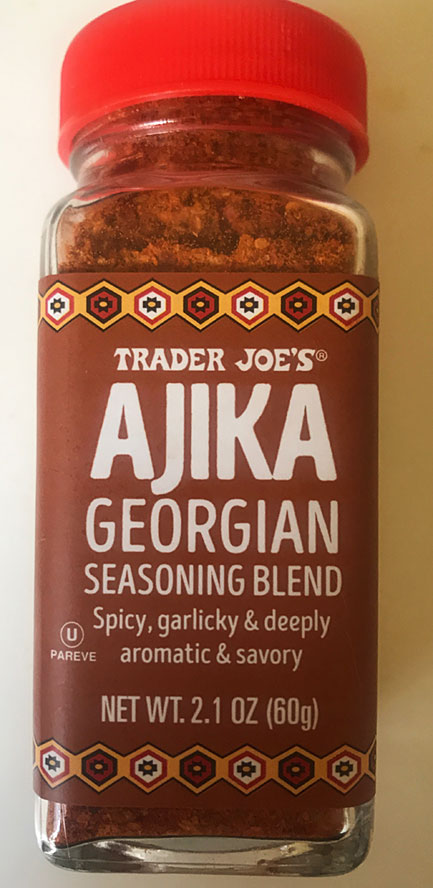
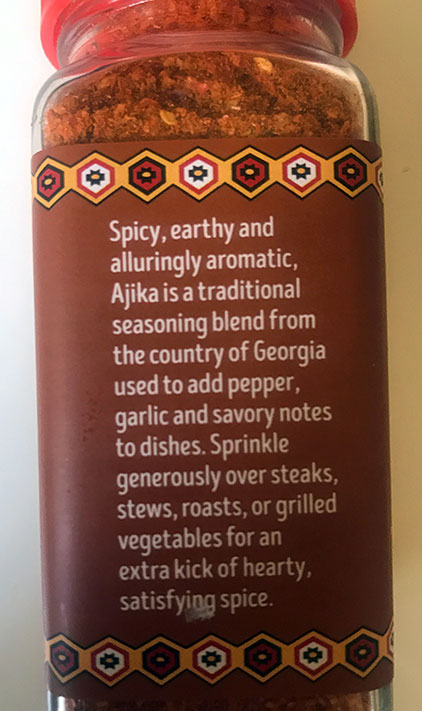
Wow is this good. Its my new favorite spice! Another delicious find I recently discovered in my TJ’s NEW PRODUCTS section. Frankly I had never heard of Ajika before seeing this. Googling it you learn Ajika is actually not a dry spice blend but is wet; more like a dip so one can assume this TJ spice seasoning blend is a dry seasoning based on the typical Georgian-Abkhaz (formerly USSR) condiment. Anyway this Ajika seasoning is just pretty amazing and a terrific addition to all of their “international spice blends” that TJ’s seems very good at coming up with.
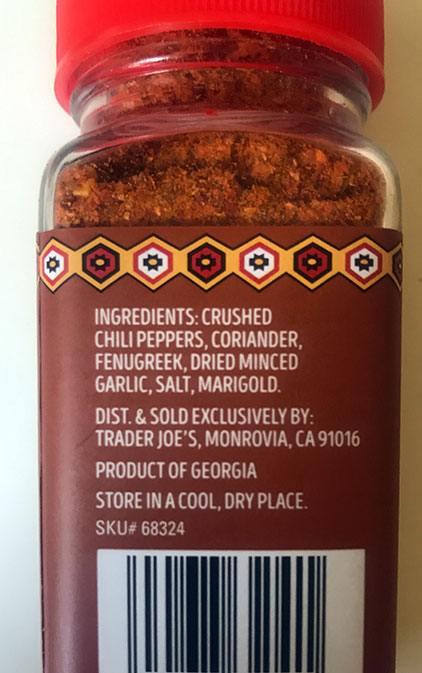
The Ajika Georgian Seasoning Blend contains ground red chili peppers (not a super hot variety), ground coriander, fenugreek, dried garlic, marigold (marigold?! yes the flower dried and ground up!) plus a little salt. Garlicky, (mildly) spicy it is more flavorful spicy than hot spicy. The coriander and fenugreek are stand out delicious flavorings that are not typical for our (American) palates. Honestly the combination of all of these spices together is seriously delicious, I couldn’t stop sprinkling it on so many foods, to see what it would do to them. It tastes quite unique to my taste buds. Is it the Fenugreek? Is it the marigold (which by the way I learn is very typical of Georgian Abkhaz cuisine).
It’s a combination of all of these things. I had made some sautéed yellow peppers and zucchini cooked in olive oil so then I put a good amount of this Ajika spice blend into it. It added wonderful flavor to the grilled veggies. I also sprinkled Ajika on top of a bagel with tomato and cream cheese and again it added great flavors. I tried in on cottage cheese, so boring right? Not with a good amount of Ajika, boring no more they went perfectly together.
Its so good you begin to wonder, what is this NOT good on? I put it on grilled boneless chicken breasts, and yes its an excellent seasoning for chicken…. or pork or steak or fish. Try this Ajika blend sprinkled on eggs or in an omelet. Try also on : Fish, shrimp, turkey, chicken, steak, hamburger, or grilled tofu for that matter. A turkey burger with a good amount of this spice is flavorful and not boring. I think it would be good with SO many things. Grilled vegetables and EVOO plus this are great. This was made for tomatoes which the original has. Mix some of this up with greek yogurt for a lovely easy sauce. You can go nuts with this. I know I am. The internet apparently is going crazy for this too. I was Wowed upon first tasting this. Yes its so good as people are saying. On a 1-10 level of heat I would put this at maybe 4, So barely spicy, very tolerable, especially mixed with foods.
If you see Ajika grab a jar to try. It may be seasonal or TJ simply testing the waters for interest. If you try this you may love it as much as I am loving it (along with the whole internet) and if you come up with some interesting ideas and/or uses for it, or some recipes, please post it in the Comments section. Oh BTW the word “Ajika” may come from the Abkhaz word for salt.
Aha Wikipedia states: “A dry form of ajika exists that is sometimes called svanuri marili in Georgian”
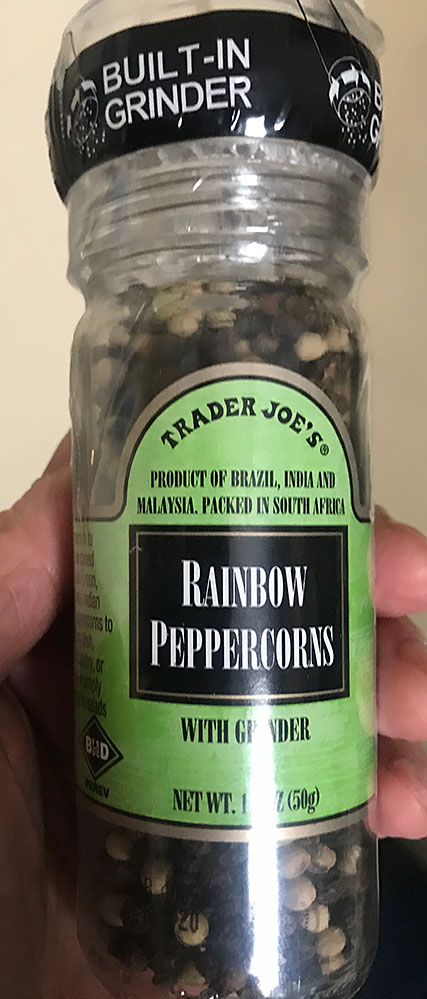
This may seem ho-hum because we are so used to seeing it by now but come on, let’s admit the spices TJ sells in built-in grinders are one of the greatest product innovations in history. I’m serious. Since all spices taste best freshly ground, it’s a huge plus that you can buy not just whole peppercorns but a number of spices & spice blends in these plastic grinders at TJs. I particularly am fond of TJ’s RAINBOW PEPPERCORNS. It’s especially nice as it’s a blend of 3 peppercorns from 3 different continents! They come from Brazil, India and Malaysia. Packed in South Africa. Wow. Peppercorns have gone up in price and I think this used to sell for $1.99, it’s now $2.29. Its the same price as a tin TJ sells of ground pepper so I would say this is better. I buy pepper grinders in pairs, one for the kitchen and one for the table.
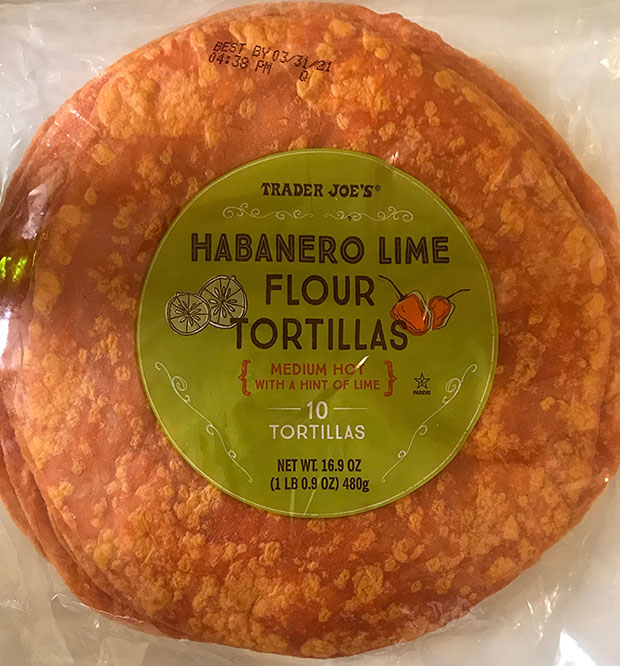
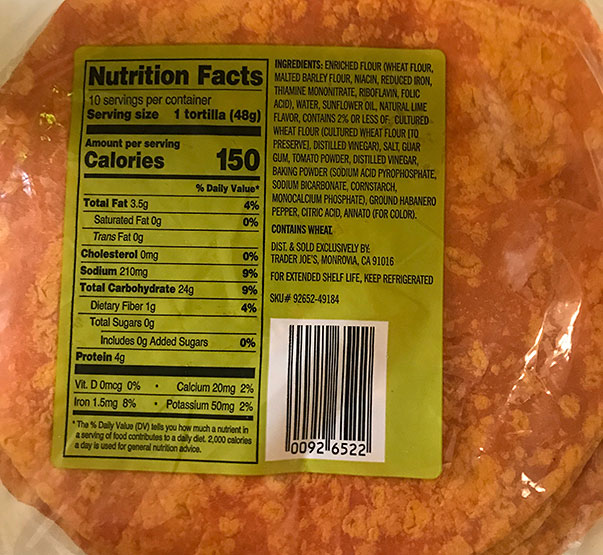
Trader Joe’s HABANERO LIME FLOUR TORTILLAS ($2.69, 17 oz package of 10)
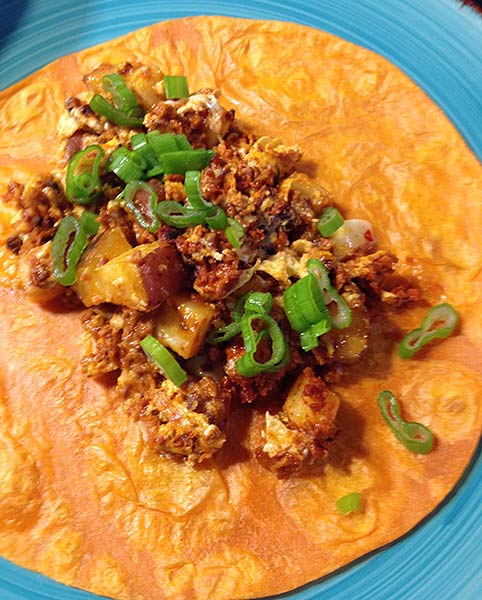
Some countries have regional food “divides”. For example traditionally in Mexico in the North they lean towards using flour tortillas (Tortillas de Harina) while in Southern Mexico mostly they prefer corn (Tortillas de maiz). I generally prefer corn tortillas as they’re more flavorful and have a chewier texture especially when cooked. Still sometimes I buy flour tortillas as they have certain qualities that make them useful for some things. For one, flour tortillas are softer and more pliable so easier to fold. They are usually bigger too so can hold more ingredients inside which is why they are used for burritos. They can also be used for sandwich “wraps” too. Trader Joe’s HABANERO LIME FLOUR TORTILLAS are an interesting choice as they bring a bit of flavor to the tortilla. These have a little bit of heat in them from habanero chiles, plus a bit of lime flavor. They have a lovely color, tinted reddish orange from anatto seed (a natural food coloring). Package says “MEDIUM HOT” but remember when you add fillings that moderates the spicy level.
Last night, I made Quesadillas (vegetarian actually) for dinner with these Habanero/Lime tortillas. Filling was: Pepper Jack Cheese, Soy Chorizo and TJ’s Refried Salsa Pinto Beans (which I gussied up*). Topping of avocado, tomato, more cheese and Green Dragon Sauce… More Refritos on the side…. They were really tasty!
TIP – Out of the can, TJ’s Salsa Pinto Refried Beans are really boring. They need a little work if you want them to have some taste. I add olive oil, oregano, cumin, chile powder and a little Green Dragon or Zhoug. Cuban Style Spice Blend works great with these or any beans. Warm frijole refritos over low heat, stirring often so the bottom doesnt burn. Some cheese on top is nice!











 Trader Joe’s Rants & Raves (mostly raves, a few rants)
Recent Comments