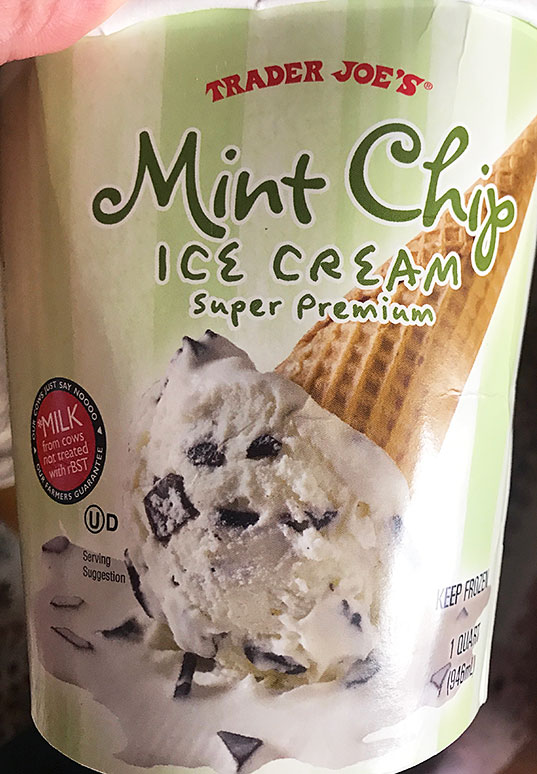
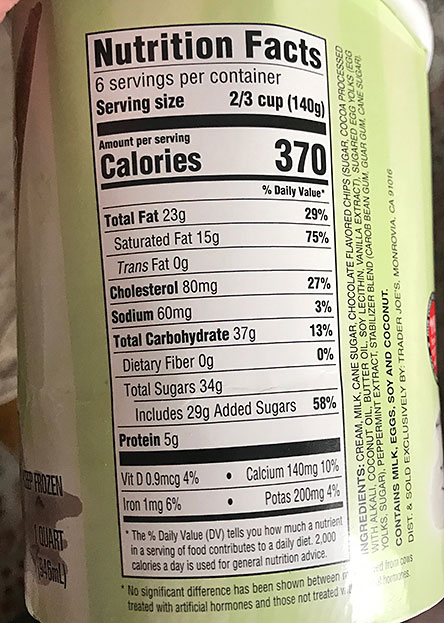
Trader Joe’s Super Premium MINT CHIP ICE CREAM (Mint Chocolate Chip)
Trader Joe’s carries many excellent ice creams and frozen desserts.
This Mint Chip is one of my favorite ice creams they have. It’s deliciously creamy with a real fresh mint flavor that is cooling and refreshing on a hot summer day. Its also loaded with little slivers of chocolate. The color is a natural, creamy white not a fake green that most commercial brands have from adding food coloring. Frankly the reason the box is a bit messed up in the pic as it was so good I didn’t take a picture until after we finished the whole package! We particularly liked this as part of a coffee float with iced coffee! This ice cream, or the wonderful Coffee Ice Cream they sell too!
I find MINT CHIP ICE CREAM is especially great in the summer time with its refreshing minty freshness. Not too mention Spring, Fall, or Winter!
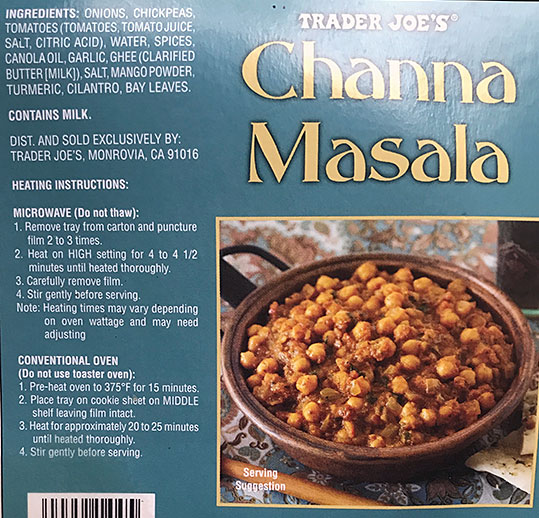
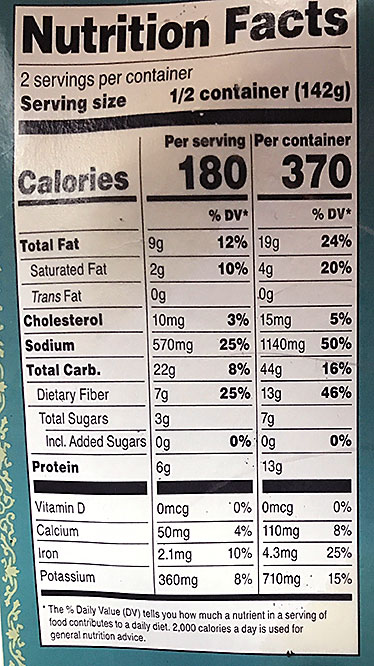
Trader Joe’s Channa Masala (spiced chick peas with onions, tomato and spices)
Vegetarian
Trader Joe’s has quite a number of very good Indian foods in Frozen. Many of them are worth exploring, but this is one of my favorites. The next time you are thinking of an “Indian food night” I would definitely recommend checking this dish out.
Trader Joe’s frozen “Channa Masala” is very flavorful and very authentic tasting. Whenever I eat this I usually think, this could have been delivered from an Indian restaurant. That is how well spiced the dish is.
To cook it, you can either heat it in the microwave or you could cook it on the stove which is the way I usually do it. I let it defrost for about a 1/2 hour, then slip the frozen puck out of the package and put in a pan with a tablespoon of water. I always eat this with Naan or TJ’s excellent Malabari Paratha and Basmati Rice.
PS – no one says you can’t add something to this. I often add something ; for example frozen spinach or some packaged “greens” (kale, etc) then another pat of butter. This variation with added greens is an excellent combo.
$1.99 (10 oz package). Higher now due to price increases.
Ever hear of SHAKSHUKA ? It’s become kind of cool and trendy in the US. Shakshuka is a popular dish all over the Middle East and North Africa, consisting of peppers and onions in a spicy tomato sauce in which eggs are poached in the sauce. Eaten with fresh pita / bread, it can be breakfast, lunch or dinner! It’s delicious and one currently see’s it in trendy restaurants around the US.
In this version found in TJ’s frozen section they have come up with a “Shakshuka starter” kit meaning this is the base sauce to which you add at an egg or two to finish it, and possibly some other things optionally. I took the package, ran some hot water on the bottom to loosen it up and then slid the contents into a pan (personally I like to cook with fire, I’m not big on microwave). I used my trusty, small black cast iron pan. Add 2 tablespoons of water, cover the pan and cook for about 6-7 minutes till nice and bubbly. When ready, make indentations with the back of a spoon, and carefully slide the eggs into the depressions. If you are talented, you can crack your eggs directly in. If not crack them into a little cup first, then pour them in. Whatever you do try not to break the yolks. The runny yolks will be important to the final dish. Put a cover back on the pan and cook for 2 minutes. Ideally we want the yolks runny. Well at least I do. I also added some cubes of Feta Cheese sprinkled around the top before covering the pan, which adds some great flavor.
Take off your cover and tuck in. You can bring the pan to the table and eat it right out of the pan – typical for shakshuka – or carefully spoon it with the whole egg onto a plate. Drizzle on some very good virgin olive oil, maybe add some chopped parsley, and break the yolks so they run all over. Mop up the eggs and sauce with a spoon and lots of bread like Pita bread (or Naan). This amount is only 9 oz, so say one portion. So you should probably make one for each person. YUMMY!
OPTIONS: you can sauté up some more red peppers and garlic in olive oil if you like and add them in. As noted, cheese such as FETA is very nice addition too. Something spicy like HARISSA, BOMBA, OR GREEN DRAGON sauce to give it some kick is a must IMO. This is not spicy as is. It’s only $1.99. Worth a try.
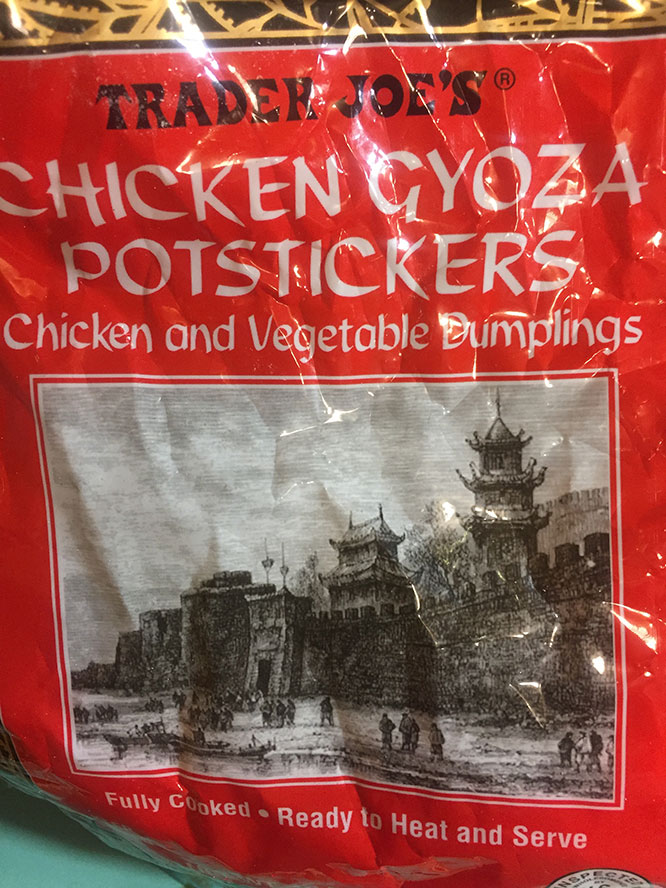
Chicken and Vegetable OR Pork and Veg. Gyoza Pot Sticker Dumplings – Perfect for now (currently Chinese Lunar New Year) or anytime of course.
Chinese dumplings are one of my very favorite things to eat. Seriously. Over my lifetime I would not be surprised if I’ve eaten a thousand of them, in one small hole in the wall place or another, mostly in Manhattan’s Chinatown or Flushing’s. Flushing especially has become a destination for dumplings with terrific places that specialize in dumplings of all kinds. I’ve even learned how to make dumplings myself, from scratch, including at times even making the wrappers! (I usually buy them in an Asian market). However that’s too much for most people. Which is where these babies come in. When you just get a craving for Pot Stickers, you can buy these frozen Gyoza Pot Stickers that TJ carries in their frozen Asian section. They’re good! They’re cheap. $3 bucks a bag. Wow.
Now I am not going to say that these dumplings can measure up against my favorites dumpling joints. Never the less the fact is I buy these bags of dumplings all the time to have on hand in the freezer for whenever I get a dumping craving and don’t want to leave the house (which let’s face it is all the time right now in the middle of Covid-19!)
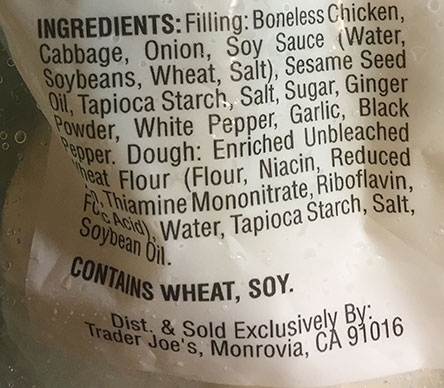
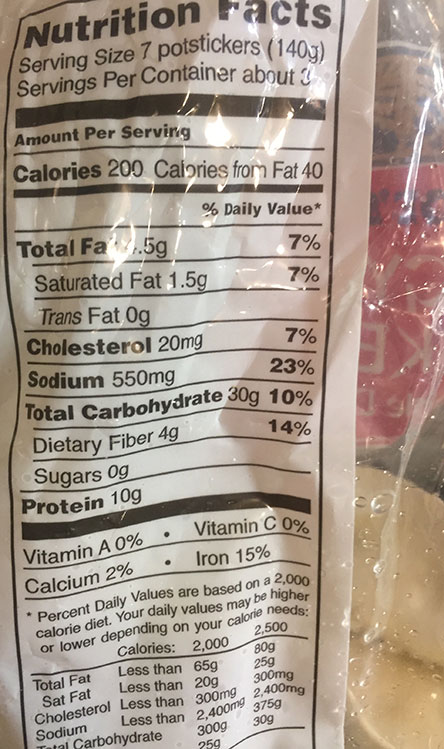
These TJ bagged dumpling are not at all bad for what they are, they are super convenient, and frankly at $3 a bag (about 21 dumplings) they are a steal. TJ sells both a Pork & Veg version and this Chicken & Veg version which I am reviewing here. As the pork one is not “porky” enough for me (I can make a decent pork and cabbage dumpling) personally I give a slight edge to the chicken ones surprisingly, as of course pork dumplings are way more typical dumplings. Buy a bag of both and see which you prefer. They’re both good. Now the stuffing of both versions are too finely ground up for my personal dumpling preferences. In any handmade dumpling you would usually be able to see chopped up vegetables which one can’t in either the pork or chicken dumplings.
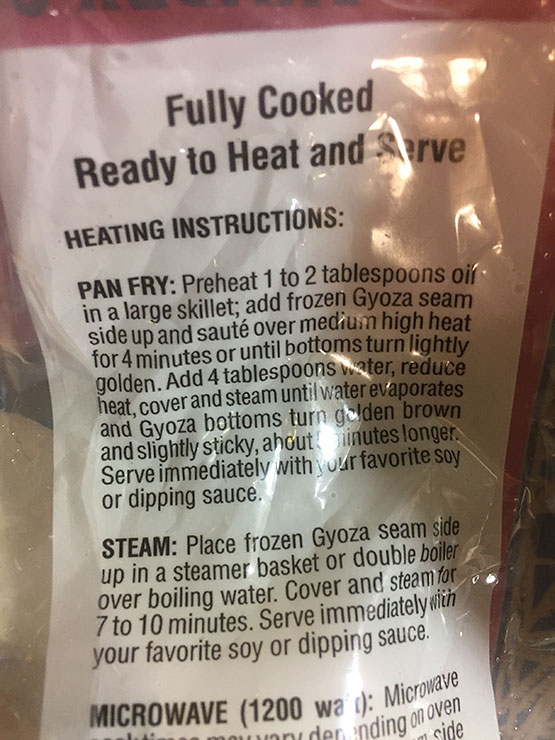
These are a tiny bit on the blandish side but a good dipping sauce can really make up for that with some nice Asian flavors in it. My first choice is to make these in a pan as Gyoza or Pot Stickers. Pot Stickers refers to first frying the bottoms, and then adding liquid to steam them, giving one the best of both worlds texture-wise in a single bite, with the wrapper both a bit crispy/chewy plus soft. The skins on these TJ dumplings are neither too thick nor too thin but acceptable in proportion to the filling. If I make them myself they would have thicker skins, be bigger and more packed with filling. But these do fine in a pinch. I have never tried cooking these in a microwave though the package states you can make them that way. Nor have I tried making boiled dumplings with these, as also suggested on the bag. If you did boil them in a strong flavorful chicken broth they might be very good that way, especially with some spinach, kale or other leafy vegetables, i.e., a “chicken soup with wontons and greens” type soup (hmm, i just gave myself an idea to try out!)
PAN FRYING YOUR DUMPLINGS: One can boil these but personally I make these mostly as Pot Stickers or Gyoza using a well-seasoned black cast iron pan. If you don’t have one of those just use a good non-stick pan. Swirl a tablespoon or 2 of neutral vegetable oil in the pan with medium heat. Put your frozen dumplings in bottoms down, careful they don’t touch each other or they will stick together. You will hear them start to sizzle in a bit. Let them cook without touching them till they are nice golden brown on the bottom, maybe 4-5 minutes…You can check one every once in a while. You don’t want to burn them however you do want very browned bottoms, Well I do! When they are browned, toss about 3-4 tablespoons of water (or stock) into the pan and immediately put a cover on! Stand back of course as they may spit or really steam up at you. Lower the heat a little. If you have a clear glass cover that’s ideal so you can see whats going on inside but if you don’t, any cover that fits tightly will be fine. We want to let them steam until the water is just about all gone which may take about 6-8 minutes. Check when you think they are done. When they are almost ready if you put a tiny bit more oil when the water is all gone and let them keep cooking they can get a quite crispy bottom which is lovely, but this step is tricky, and optional. Anyway this is the reason these dumpling are called “pot stickers” as they do tend to stick to the pan and not want to leave it! If they are a bit stuck use a thin spatula to gently help release them, being careful not to tear the skins.
You should to eat your Gyoza right away while they are nice and hot, so timing is critical. What we do, is we get everything ready, then take just 2 or 3 dumplings at a time on our plates, cover the pan with the heat off to keep them warm and come back to fill up with a few more when we finished the first ones. That way you always eat warm dumplings. In the first picture you can see I served them with edamame and peas which were a great match with these dumplings to add in more veggies. You can serve them with a little rice too and any kind of veggie or salad. We can usually eat about 6 each easily as the Main, along with other stuff though they can be just an appetizer of say 3 or 4 each. I strongly suggest eating lots of green veggies with these. Edamame go great. If you can get Bok Choy or Choi Sum, that would certainly go well. And toss lots of chopped scallions all over these when you serve them.
Many countries have some variation of pot sticker dumplings. In Korea, “Mandoo“. In Japan they are called “Gyoza“. In China, Jiao-zi or Guo-tie.
You always eat dumplings with a dipping sauce. One classic sauce might be Chinese Black Vinegar* with lots of julienned ginger. Or soy sauce plus vinegar, sugar, ginger and garlic. TJ sells a bottle of “GYOZA DIPPING SAUCE” which is fine if making your own sauce is too much trouble. I frequently use TJ’s diping sauce and add just add a few things to it (like Lao Gan Ma, chili sauce) If you like fresh cilantro it’s wonderful with dumplings. Something spicy to add a kick if spicy is your thing, like me. Green Dragon hot sauce for example is great with these! TJ’s Sweet Chili sauce is also lovely! I mean a bit mixed into your dipping sauce.
While I can’t say these TJ frozen dumplings compete with the best Chinese homemade dumpling places I have gone to, these are quite decent and make up a great deal with the convenience of being able to have them anytime you get a craving! These bagged ones are such a bargain for $2.99 a bag (UPDATE: now $3.49). TJ has a number of other “fancier” dumplings in the frozen section in boxes which cost a bit more but frankly I keep coming back to these cheaper bagged versions. I tried TJ’s Pork and Ginger Soup Dumplings and frankly was not impressed. Not surprising as making Xiao Long Bao is a pinnacle of the art of dumpling making. I’ve eaten them at some top dumpling restaurants like Nan Xiang Xiao Long Bao in Flushing, Queens (fantastic! go if you get a chance).
Chinkiang Black Vinegar can be found at most Chinese or Asian groceries (5-6 dollars?) If you can’t find it and don’t mind paying through the nose Amazon sells it. It’s a classic, pantry item.
SIDEBAR: In New York City if you want terrific pan fried or boiled dumplings I check out VANESSA’S DUMPLING HOUSE which I first enjoyed 20 years ago in her original tiny hole in the wall joint on Eldridge Street where no more than 4 people could fit. Her product was fantastic and word grew about her amazing dumplings which went back then for the amazing price of 5 for $1! Vanessa’s business grew and she became a very successful immigrant entrepreneur who kept expanding and improving and now has multiple beautiful places. If you eat her pot stickers or any of her many kinds of dumplings you will learn what really good dumplings taste like. They do cost more though now! Finally, if you really are interested in learning more and maybe trying your own hand to make dumplings you will find lots of great info here
I really enjoy the Naan Indian breads that TJ carries. These frozen Naan breads are tasty and super convenient, only requiring warming up. They are “handmade in India”. A package of 4 Naan is just $1.99, wow! TJ sells two frozen versions, this plain Tandoori Naan and a Garlic Tandoori Naan version which includes garlic and cilantro. I buy a pack of each kind to keep in the freezer. They’re both really convenient and quite good.
Naan breads can be used for so many things. Of course these flat-breads go great with any of TJ’s pretty numerous Indian food offerings but Naan can be used anywhere a flatbread type bread would be good… with saucy foods, soups, etc. Bake these with cheese on top, or some ham or prosciutto, and you have a terrific easy creation. Pizza with sauce? Sure, I’ve done them that way*. Your imagination is the limit on what you can do with these.
To heat them you can throw these into a regular or toaster oven, or sometimes just throw them in a cast iron pan. Hit them with some olive oil or butter or ghee and they become even more tasty and a little crispier. I sometimes add butter and fresh crushed garlic and these are fab. Or just buy the excellent Garlic Naan version if you don’t want to smash your own fresh garlic. The Garlic Naan ones are really flavorful with some green stuff (cilantro or scallions).
So with your next TJ Indian feast, grab some Naan while you’re at it. A package of maybe TJ’s frozen Channa Masala ($2.29 and delicious) or foil pack of Tadka Dal ($1.99) plus some Naan and some tomato and you have a dinner in 3 minutes for a few bucks that is as good some takeout. I even made my own Tadka Dal and ate it with this Naan. Since I had extra dal, I gave some and 2 naan to my upstairs neighbors who thanked me profusely and told me they devoured it in minutes and that it was as good as an Indian restaurant.
TJ also sells some non-frozen Naan breads in the fresh Bread section. These Naan however cost more, they’re bigger and thicker.
You can make these in pizzas using Naan as your base. These naan are kind of thin so if you want a bit thicker base, get the fresh Naan version TJ carries in the fresh breads section. Though they sell a Pizza base there too!
“Trader Joe’s Argentinian Red Shrimp are caught off the southern coast of Argentina. They have a sweet lobster like flavor and texture. Grill, barbecue or sauté. Serve with pasta, on salads or as an entrée…” (Wild, Raw, Peeled, Cleaned and Deveined Frozen Shrimp)
WILD CAUGHT, PRODUCT OF ARGENTINA
Ingredients: shrimp, salt
FYI – Shrimp is the most popular seafood in the United States, but in reality only a tiny fraction comes from domestic U.S. sources. Ninety percent of the shrimp we eat is Imported, and almost all of that comes from shrimp farms in Southeast Asia and Central America.
If you’re looking to buy shrimp at Trader Joe’s I would check out their wonderful Wild Argentinian Red Shrimp. These are the best shrimp Trader Joe’s sells. In fact these are some of the best shrimp out there, period. These Patagonian Red Shrimp are from Argentina. First off, these are Wild Caught, not farmed, shrimps. Wild shrimp are said to have better flavor than farmed, plus be better for the environment.They’re large, meaty and actually do have a sweet lobster-like texture and taste. Some people think of these shrimp as “poor man’s lobster”.
Patagonian Red Shrimp, are fished from the icy waters off Argentina’s coast in Patagonia. They are individually flash frozen, cleaned (and deveined) and ready to use. They’re a quite decent size (20/25 count aka “Large”).
Are these truly “the sweetest shrimp in the world”? … well even if some marketer came up with that, they actually do taste kind of sweet and have what many people think of as a “lobster-y” texture as well as taste.
How To Use These Shrimp: You use these red shrimp the same as any other. Be careful NOT to overcook them of course. If I’m not using the whole bag I just take out as many shrimp as I need , and close the package up super tight with a twisty, and double bag the package inside a Ziplock freezer bag (double bagging these will help keep out freezer burn).
So first things first, what are the best defrosting method(s) for these frozen shrimp?
DEFROSTING : The best method to defrost them is the traditional overnight thaw in the fridge in a covered glass bowl. Thats the best way. Still if you didn’t plan ahead to do that, the next best option is to put them in a plastic baggie, and run a light stream of cold running water over the bag (you can weigh down bag with a cup or plate). The shrimp should be defrosted in about 15 minutes or so. This last method works OK too in a pinch: I’ve simply put the frozen shrimp in a bowl, covered them with an inch of cold water, and stirred them every 5 minutes or so. Defrosting this way should take maybe 15-20 mins. Cooking from frozen: No way, I would not recommend doing that. They will shrink up a lot and be tough. Microwave also a no-no, you will ruin the texture of the shrimp.
Cooking: Cook these red shrimp the same way as any shrimp. However these do seem to cook a wee bit faster so be careful not to overcook them. If you are say using a sauce, you can simmer the (defrosted) shrimp slowly in the sauce at the very end, cooking them in the sauce for maybe 2 minutes or so (turning them over once). As soon as they are no longer translucent and look firm these are cooked, and/or at least should be removed and then added back to your dish at the end. Not over cooking will keep them plumper and juicier. When you overcook shrimp they become chewier and shrink up.
TIP: If grilling them, you can marinate them for 15 min in lots of TJ’s CUBAN SPICE BLEND. Or any spices of your choosing. Ajika blend also is terrific as is TJ’s spicy Peri-Peri Sauce. Another great spice for these? TJ”s new blend HOT & SMOKY PAPRIKA
These shrimp are terrific simply sautéed in olive oil with lots of garlic, scampi style. You can blot them with a paper towel, optionally sprinkle them with a little seasoned flour and sauté them in oil and butter. One trick I saw on MilkStreet recently was to pan fry shrimp on one side only, then take them out of the pan and later finish them in your dish for 30 seconds at the end. This is a great idea, as you won’t overcook them.
These shrimp are of course great grilled / sautéed and excellent in a pasta dish. You can put them on a skewer and broil or grill them (brush with oil). They are equally great gently poached, about 3 minutes, which is a good way to make them for cold cooked shrimp or for the top of a salad.
If you try these shrimp you will probably like them as much as we do. I find them super convenient to have in the freezer. TJ’s sells the Wild Argentinian Red Shrimp (1 lb. bag) for $9.99
*UPDATE-1 (Feb 2021) price increase to $10.99. UPDATE-2 (Apr 2022) price up again, now 11.99
On this site not only do these get top ratings, they are called the “lobster impersonator”
More cooking ideas follow.
Dishes: I made a nice Thai Shrimp Curry with the shrimp, veggies and TJ’s Thai Red Curry sauce – adding the shrimp the last 2 minutes (a no-recipe recipe follows below).
THAI STYLE SHRIMP CURRY – Sauté some onions, garlic, and chopped ginger in oil for 4-5 minutes. Throw in chopped up carrots, celery, potatoes (optional add ins: mushrooms, peas, sweet potatoes, scallions) …sauté everything for 5 more minutes, then add 1/4-1/2 cup liquid (water or broth (Option: Add a 1/2 cup Coconut Milk for the liquid)) Simmer for 10 minutes, then add in a jar of TJ Thai Red Curry sauce and simmer another 10 minutes or until all the veggies are just tender. The last 2 minutes of cooking, you add your shrimp and simmer gently in the sauce, stirring occasionally. Serve the curry with jasmine rice and add chopped scallions on top.
Shrimp Roll on Brioche Bun (aka The Poor Man’s Lobster Roll)
Here’s one more: As these shrimp are kind of “lobster-y” they are perfect to make a New England style Shrimp Roll (aka the Poor Man’s Lobster Roll). Gently poach the shrimp 90 seconds or so just until opaque and pink (don’t over cook them). Rinse them under cold water. Split or cut them up and mix with a little mayo and lemon juice, then put them in a lightly toasted buttered Brioche bread or Brioche Bun (spread with a little mayo). If you have some, sprinkle a little Old Bay seasoning or dill seasoning on top. Easy and delicious.
(NB: TJ’s recipe here says cook the shrimp for 5-10 mins; I suggest thats too long unless you want overcooked shrimp. I say cook these shrimp about 2-3 minutes)
Ramen? Yes. I used the shrimp in (“Roy Choi style”) instant ramen with a slice of cheese and butter.. (crazy but it works, see video below). For this dish which was a dinner, I made a veggie stock instead of using the included packet of seasoning* and added some fresh mushrooms. I added the defrosted shrimp at the very end of cooking, and only cooked them about a minute or two. See they look juicy (not overcooked)? TIP: That little flavor packet included with instant ramen is just loaded with Sodium (like 50-70% of daily recommended level)? Bad for you, so better to use your own stock or a low sodium stock and maybe just add a pinch of the flavor packet. Worst case, use only half the packet and if it tastes too flat, add something to flavor it up without adding much sodium (a dash of low sodium soy sauce or a few drops of Nam Pla (fish sauce).
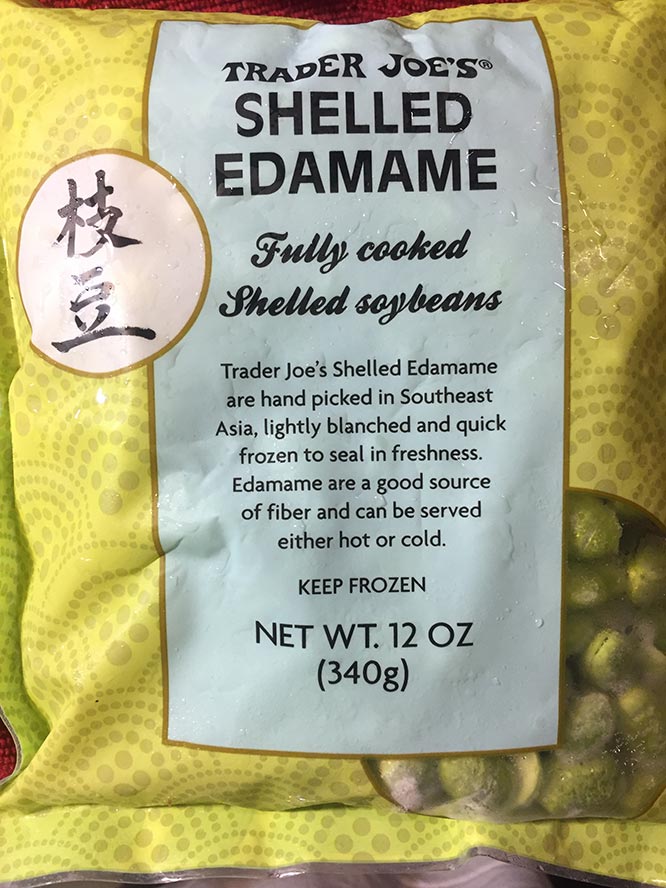
Trader Joe’s sells two versions of EDAMAME (Soy Beans), these shelled ones as well as unshelled, in the pod.
Both kinds are excellent, really tasty and not to meantion super healthy. You should add either or both to your diet if they are not already on it.
Maybe you first encountered Edamame in a Japanese restaurant when a waiter put a bowl of kind of fuzzy and weird looking pods on the table? Someone told you to nibble on them and to suck the beans out that were in these pods. Served this way edamame are typical “bar snacks” you would find in a restaurant or Izakaya (pub).
These are beans/legumes so of course edamame are good for you. As well as very being quite DELICIOUS. They have a taste a bit like peas but nuttier and earthier. I like them both versions, in the shell and out of the shell, so I usually buy a bag of both. As a side dish you can’t go wrong with Edamame with a pinch of salt and some butter. Yummy!
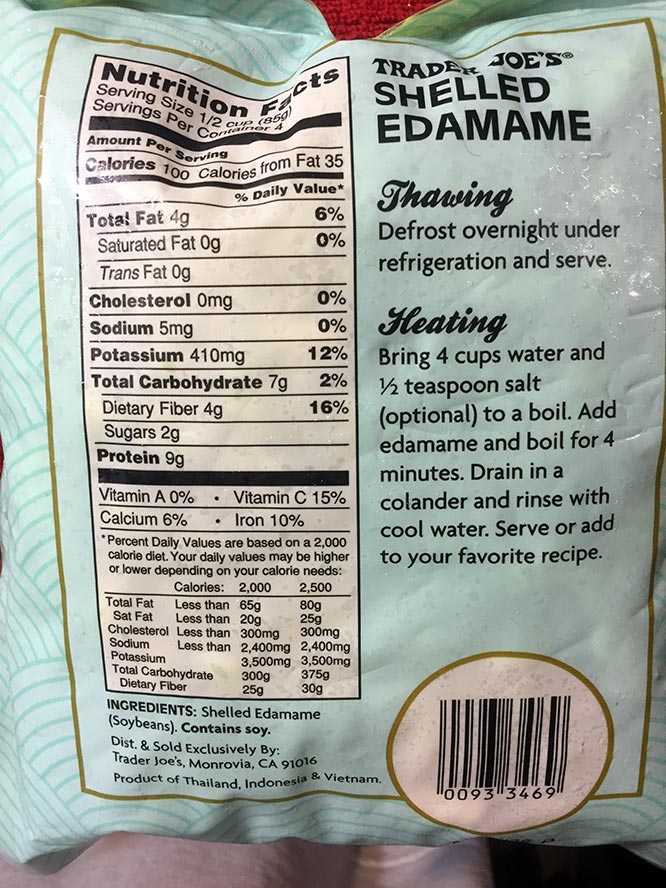
TJ’s frozen Shelled Edamame are convenient, as you don’t have to peel them of course if you just want the beans. Useful as a side dish, the same way you would serve some peas, or for adding to a dish, such as a rice dish*, again exactly as one might add green peas. When I add edamame, say to rice in the last 3 minutes, I don’t cook them first as the bag suggests (they are already cooked in fact). I just put them in a colander, rinse them till they are no longer frozen and then toss them in the pot of rice (or whatever) for maybe 3-4 minutes. Or use them, as an addition to your favorite recipe. Soy Beans contain Lots of protein (9 gr in a half a cup!), lots of fiber, vitamins and basically everything that is Soy Good for you. Maybe one of the healthiest things you can eat. A 12 oz. bag of the shelled version is $1.99 which is less than in a Asian specialty store where you normally find these goodies. And about $1.69 (1 lb) in the shell, which are of course great to serve people to nibble on and suck out of the shells in the traditional style. Maybe the kids would like those, as they are very hands on, play with your food.
I picked up a package of Trader Joe’s “Wild Soy Ginger Marinated Cod Fillets” in the Frozen section at TJ’s to try. I was quite satisfied, this dish turned out to be really good. This marinated cod costs about $7/lb. – very much on the lower price end for almost any fish these days, and this is wild caught cod from the Atlantic, so another good find at TJs.
This cod is tasty, and easy-peasy to make. I followed instructions on the package about defrosting them overnight in the fridge. An overnight thaw in the fridge is always the best method for defrosting as thawing slowly is best to preserve the original quality. So just remember you need to think about this the day/night before if at all possible. If after an overnight thaw, you find its not completely defrosted when you are ready to cook you can put it in the sink in a pot and run a stream of cold water over the unopened package for 5-15 minutes till it feels completely defrosted. I didn’t try the method on the package where they say you can defrost in a bowl of warm water, in fact I would completely say never use warm water, its too fast and damages cell structure. If you really need to do a “quick defrost” again run a stream of cold water on it till defrosted (again, “emergency only” method). A fish monger told me to do it with cold running water.
On the package they suggest 3 methods to cook the cod – in a skillet, bake it or microwave it. Me, I decided I would cook the miso cod by broiling the fish and glazing them with the marinade. Broiling is a typical Japanese method of cooking. I took the fillets out of the package with tongs careful to reserve all the marinade for later use. I placed the drained defrosted fillets in a black cast iron pan (my favorite cooking utensil), dotted them with a little butter and put the pan under a very hot (pre-heated) broiler. The fillets were not thick. One was a little bit thicker. So I cooked the fillets for about 3 minutes then took the pan out of the oven so I could pour over that reserved marinade over the fillets. Aha! The reserved marinade will make you a very nice soy miso glaze. So I immediately put the pan back under the broiler to finish for about just another minute or two, keeping a close eye on the fish and the glaze which was all bubbly and browning up. As you can see the glaze browns up beautifully, thickens, to make a nice sauce for the fish, and obviously keeps the fish moist and not dried out. You can even put another little bit of butter in the pan and hit the fish with freshly ground pepper, and a squeeze of fresh lemon. I forgot to mention I threw in some frozen shelled Edame (soy beans) around the fish to cook with it. The edamame were a perfect match with the fish, along with some some rice. There’s a Japanese meal for you.
We really enjoyed this. Sometimes cod fish can be a bit boring but this miso / soy marinade treatment makes this product very good. You can hit it if you like with even more freshly grated ginger (I generally do).
To sum up I found TJ’s Soy Ginger Marinated Wild Cod Fillets to be super convenient, easy to make, and really tasty. I would buy it again, and in fact have a few times since I first tried this. This is becoming a Go-To item for me at TJ now and I usually have a package in our freezer.
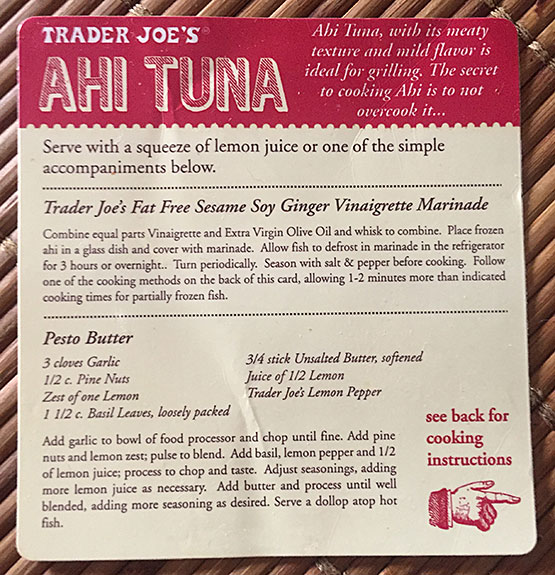
“The secret to cooking Ahi Tuna is not to overcook it”
What is Ahi Tuna? “Ahi” is Hawaiian for YELLOWFIN TUNA
“Yellowfin tuna, scientifically known as Thunnus albacares, is a popular species of tuna found in tropical and subtropical waters worldwide. They are often marketed as “ahi” in Hawaii and elsewhere.”
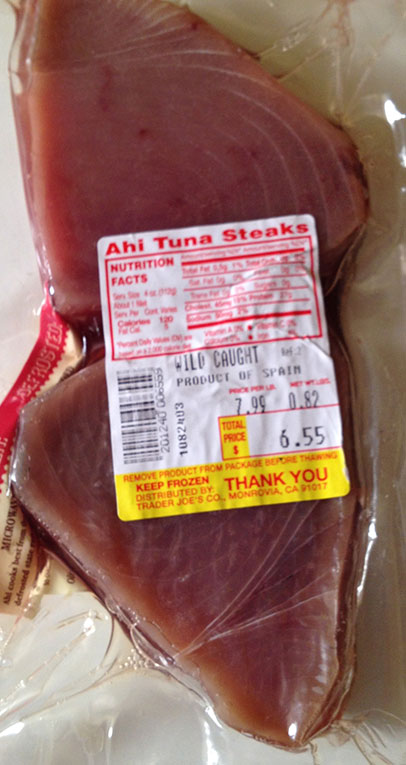
Trader Joe’s sells AHI TUNA STEAKS, in the section with their other frozen fish.
My package was labled “Wild Caught, Product of Spain” (fished from Spanish waters in the Atlantic)
Ahi Tuna is one of my favorite fishes that TJ’s carries. and I highly recommend trying it if you never have before. It’s so good, meaty and satisfying.
If you have any leftovers, its delicious served cold the next day, maybe over a bed of rice or a salad.
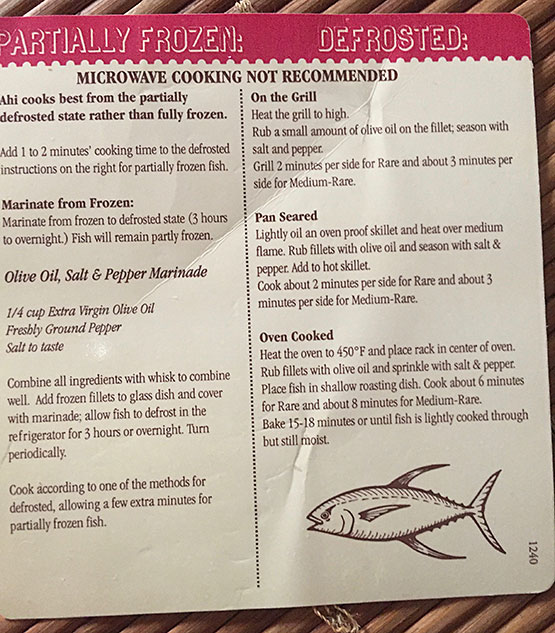
How To Cook Ahi Tuna: First off, defrosting the fish. The best way will be a slow “overnight” defrost in the fridge. While the slow defrost will give the best result, if you didnt plan ahead, you could you can try putting the package of fish in a bowl in the sink, then running a slow stream of cold water over it. Leave it like that. That will take perhaps an hour to defrost that way.
TIP: Do Not Nuke the fish to defrost it; it will ruin the texture of the fish, making in mushy.
The package states you should “remove from package before defrosting”. I’m not quite sure why… anyone have a clue? Anyway I defrost it in the fridge overnight in the package and it seems fine.
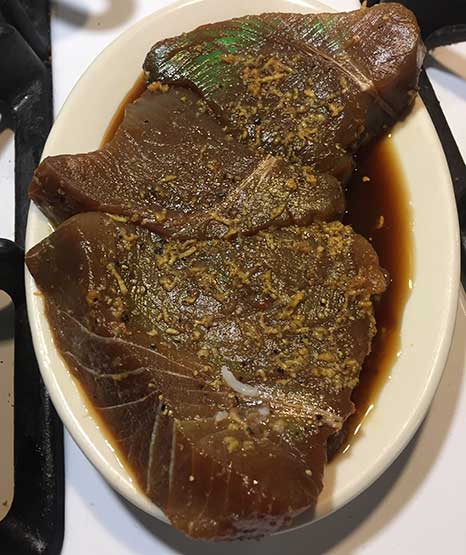
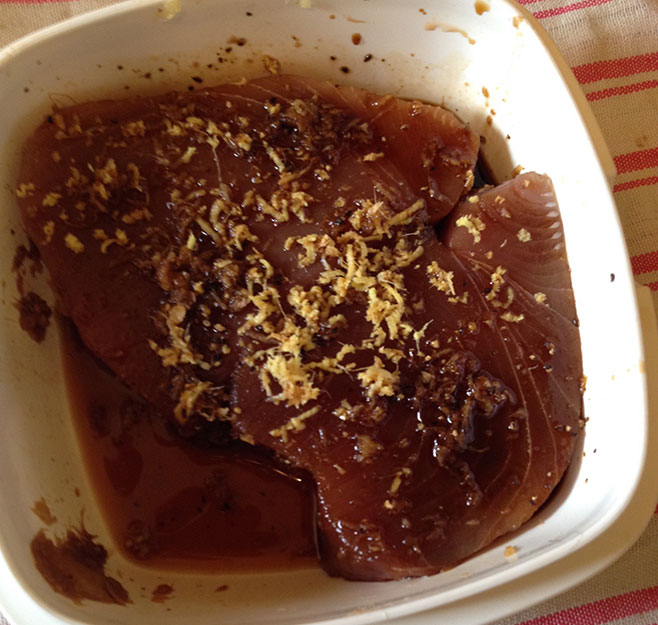
MARINADE: Once the fish is defrosted I marinate it for a half hour to an hour before cooking. As far as marinades go, I generally make a typical Asian/Japanese style marinade: Soy sauce, fresh grated ginger, fresh ground black pepper, a pinch of honey or brown sugar, plus some oil, either olive oil or better still a teaspoon of TJ’s dark roasted sesame oil. You can add some type of acid if you like: a tiny amount of cider vinegar, lemon juice, or sake if you have it. You should serve it with some fresh Lemon or Lime.
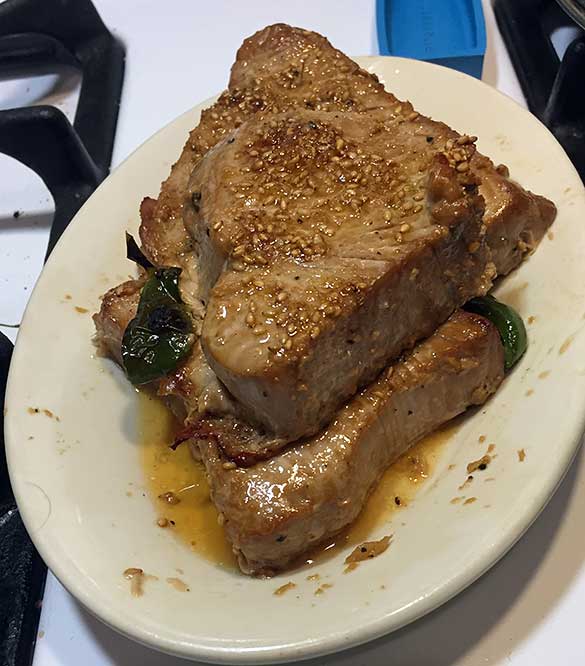
Cooking Ahi Tuna: The first rule of AHI tuna is don’t overcook it. Its very easily overcooked. It is crucial that you don’t overcook ahi tuna as it can dry out easily. So be careful with your cooking time. Personally I think AHI is best cooked in the Japanese “Tataki-style” way which is just searing the outside on all sides and leaving the center a bit pink (See pic above).
I generally cook it in a black cast iron pan over med-high heat with a little oil, and/or butter, searing the outside for 60-90 seconds on one side then turning with tongs to cook the other sides for a minute. You can use the tongs on the sides but again be careful not to overcook your fish. After you do it once or twice you will get the hang of cooking this way.
When done, take the fish out of the pan, and let it rest on a plate for a few minutes before you slice it. Which you will do against the grain like a steak. Be sure to save the pan juices and any juice that runs out on the cutting board to pour over your fish.
You can deglaze the pan with sake, rice vinegar, or even a splash of water, or some extra marinade that you saved at the beginning. I found that if you marinated the fish and use that marinade to deglaze the pan there is protein that coagulates when you cook it, so it glops up a little (I just thin it with soy and some water, it doesn’t bother me too much, it makes it thicker thats all). If that gloppy stuff bothers you, don’t use the marinade, make a fresh sauce to serve with the fish. Here’s some ideas for sauces….
“Butter Shoyu” (Soy Butter Sauce) Put a fat dollop of butter in the pan along with a little soy sauce, a terrific combination. Mix it well and and pour over the Ahi. Serve with slices of fresh lemon or lime.
PONZU: Another classic Japanese sauce. Combine Soy sauce and fresh Lemon Juice. Do not cook this, just mix together. A bit of grated lemon rind would be a gourmet touch.
As in the photo of my finished Ahi, it should end up seared on the outside and pink in the center, just how pink is up to you. I like mine like it is in the thickest part, the center (just this side of raw) while my wife likes it as it is cooked on the ends (medium) which I think of as overcooked. As a final touch, I sprinkled some sesame seeds on top, sliced it against the grain, and put it on a bed of arugula, pouring the pan juices over the top. Ahi Tuna is really delicious and I am sure your family will also love this very steak-y fish.
You could even try it as “Poke” I guess (ceviche style). I am willing to eat it this way but my (Japanese) wife won’t let me make this as poke as she says this is not “sashimi grade tuna” (true) which costs three times as much, selling for about $25/lb instead of this at $8/lb. So at 8 bucks a pound this is a another good deal from Mr. Trader Joe.
ASIAN MARINADE: 2 tbs soy sauce; 1″ peeled fresh ginger, grated; fresh ground black pepper, a little honey or brown sugar, teaspoon of sesame oil (or olive oil) plus lemon or lime juice for a marinade (you can make a bit more and save some to serve on the side). Marinate in the fridge (on fully defrosted fish) for 30-60 minutes turning it once. Cook as desired.











 Trader Joe’s Rants & Raves (mostly raves, a few rants)
Recent Comments